
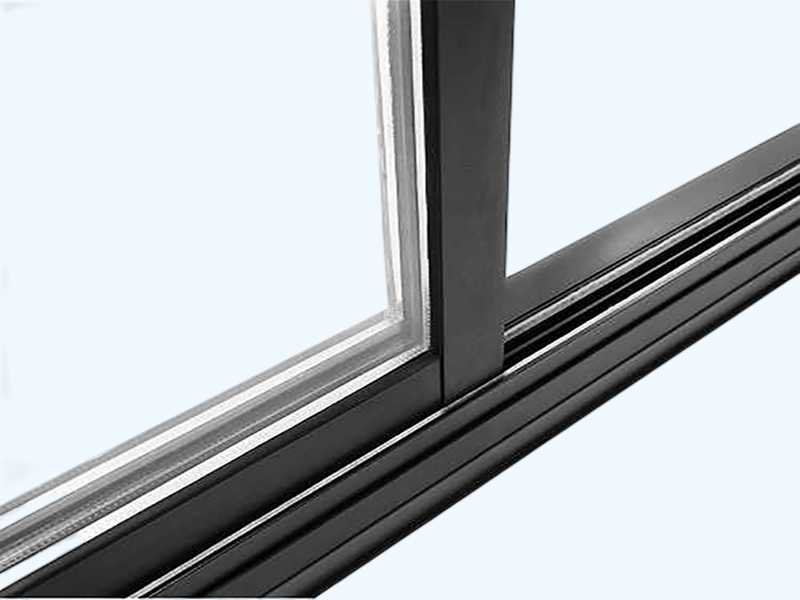
A polyurethane door frame profile serves two functions simultaneously: it interrupts thermal migration across the entrance perimeter and provides the structural spine required to carry heavy, oversized commercial door leaves without sagging. The profile features a multi‑cavity pultruded PU-GRP structural matrix with an integrated high‑density polyurethane insulating foam core. This hybrid combination yields a thermal conductivity through the section typically ranging between 0.15–0.30 W/m·K when tested per ASTM C518. Equivalent international methods may include EN 12667. Longitudinal flexural modulus typically ranges between 40–55 GPa, helping keep mechanical corner joints square and stable season after season. For a thermal break door profile specified in passive house envelopes or harsh cold‑storage environments, this thermal performance helps prevent localized frost formation and supports structural envelope targets.
The exterior surface of an insulated door profile features an aliphatic UV‑stabilized gel‑coat or a paintable cross‑linked polyurethane skin. This structural skin accepts heavy‑duty architectural top coats without special priming, allowing the finished door systems to visually match adjacent aluminum curtain walling on the same elevation. The profiles are manufactured in standard industrial frame depths of 70 mm, 80 mm, and 100 mm, with wall thicknesses engineered to securely anchor multi‑point panic locks, concealed heavy‑duty door closers, and dropped threshold seals. Because the non‑porous PU composite typically absorbs negligible atmospheric moisture, it generally eliminates the swelling, warping, and edge‑sticking common to traditional timber or insufficiently reinforced PVC frames in high‑traffic commercial vestibules. Longitudinal tensile strength typically ranges between 700–1,100 MPa when tested in accordance with ASTM D638, with actual values depending on fiber architecture and profile cross‑section.
Frame fabrication utilizes precision miter‑cutting and heavy‑duty mechanical corner cleats bonded with PU‑compatible structural adhesives. No thermal‑bridging metal fasteners or structural welds are required, maintaining a continuous thermal barrier across the entrance head, jambs, and sill. Flame spread index is generally ≤ 25 when tested per ASTM E‑84; Euroclass C‑s1,d0 self‑extinguishing classification is available. Surface finish options include co‑extruded UV‑stabilized gel‑coat or architectural paintable skin, with custom RAL color matching.
Proven in Field
"The multi‑family development had a strict passive house target and the main entrance doors were the last remaining thermal bridge. We specified WayTong's PU composite door frames with an 80 mm depth. The final building blower‑door test came back at 0.45 ACH, comfortably below the 0.6 ACH passive threshold, and the frames have shown zero structural warping or latch‑sticking through three severe winter heating seasons."
— Passive House Entrance System Study
Review Frame Specifications & Thermal Performance Data
WayTong supplies PU composite door profiles in standard frame depths of 70 mm, 80 mm, and 100 mm with custom RAL color matching. Contact our technical desk for project‑specific U‑value calculations, hardware compatibility verification, and passive house certification support.
Request Technical InformationThese profiles integrate with the broader WayTong PU Composite Profiles family—including window frames and structural thermal break connectors. For complete thermal and mechanical performance data, see the ASTM Standards Summary.