
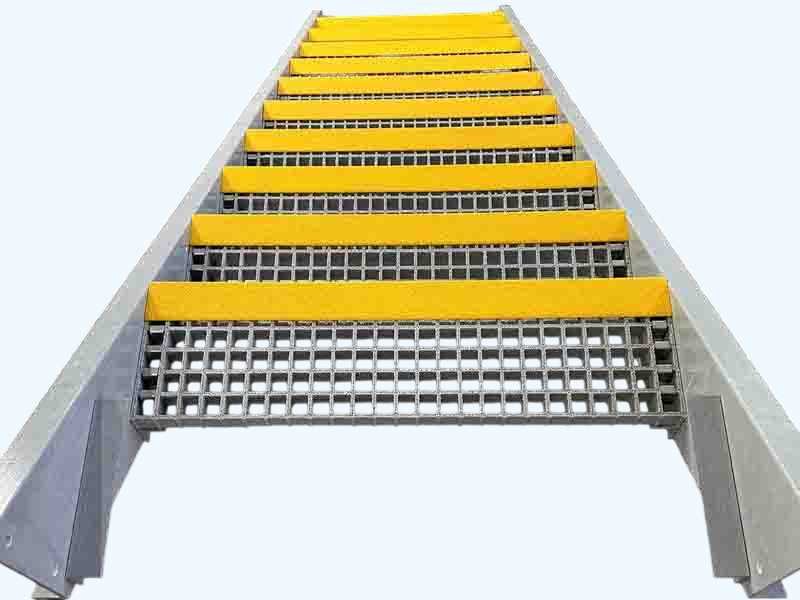
Our fiberglass stair tread combines a pultruded FRP structural body with an integrally bonded, grit‑coated nosing. The grit is silicon carbide, which means the slip resistance is built into the tread itself, not a piece of tape that curls up after a season. For plants in chemical processing or coastal washdown areas, this matters. The tread generally delivers the same coefficient of friction under wet, oily, or highly corrosive conditions that would degrade conventional steel treads in months. Slip resistance performance is commonly evaluated under ASTM D2047.
This tread is designed to drop into standard stringer profiles. The 102 mm depth and nosing profile suit 45‑degree industrial stair stringers, and while the tread itself is light enough for one person to carry up a column, the glass‑reinforced structure handles point loads that would twist a typical metal checkered plate. If your site already runs FRP walkway systems, adding the matching tread keeps the corrosion‑resistance chain unbroken.
Standard depth is 102 mm (4 in), suitable for 45° stringers. Surface options include open‑mesh grit top or solid concave grit profile. Fire performance generally achieves a flame spread index ≤ 25 when tested per ASTM E‑84, meeting most industrial insurance requirements. Resin systems include isophthalic polyester as standard, with vinyl ester available for severe chemical exposure. Weight is approximately 2.7 kg per linear 100 mm width. For related platform access and safety solutions, see FRP Access Systems and FRP Walkway Applications.
Standard Dimensional Parameters
Commonly available panel dimensions and sectional specifications for FRP stair treads are listed below for reference. Custom lengths, widths, and surface configurations are available for project‑specific stair designs.
| Parameter | Commonly Available Specification |
|---|---|
| Panel Length (Span Direction) | 600 mm, 700 mm, 800 mm, 900 mm, 1000 mm, 1200 mm |
| Panel Width (Tread Depth) | 250 mm, 300 mm, 350 mm |
| Panel Thickness — Light Duty | 25 mm |
| Panel Thickness — Standard Duty | 30 mm |
| Panel Thickness — Heavy Duty | 38 mm |
| Mesh — Standard Square | 38 mm × 38 mm |
| Mesh — Small Aperture | 25 mm × 25 mm |
| Nosing Height Above Tread | 10–15 mm |
| Nosing Surface | Integrally bonded silicon carbide grit; yellow safety colour (RAL 1004) |
| Nosing Width | 50–75 mm front edge coverage |
| Toe Board (Optional) | Flat bar 100×5 mm, 100×6 mm; length matching tread width |
| Stringer Profile (Compatible) | C‑channel 100×50×6 mm, 125×50×6 mm |
Custom panel lengths up to 1200 mm and non‑standard tread depths are available on request. For coefficient of friction test reports, load‑rating data, and project‑specific compliance documentation, see the referenced ASTM D2047 and ASTM E‑84 performance figures above.
Proven in Field
"After replacing steel stair treads with FRP versions across the platform, the operator recorded a 60% drop in slip incidents over two years and eliminated recurring repainting—pushing the expected tread life beyond five years."
— Offshore Platform Grating Upgrade
Request Stair Tread Specifications & Slip Resistance Data
WayTong supplies FRP stair treads with integrally molded silicon carbide grit nosing for standard 45° industrial stringers. Contact our technical desk for coefficient of friction test reports, custom widths, and project‑specific compliance documentation.
Request Product InformationThis stair tread integrates with the WayTong FRP Access Components portfolio alongside handrail systems, fixed ladders, and guardrails. For complete mechanical and fire performance data, see the ASTM Standards Summary.