
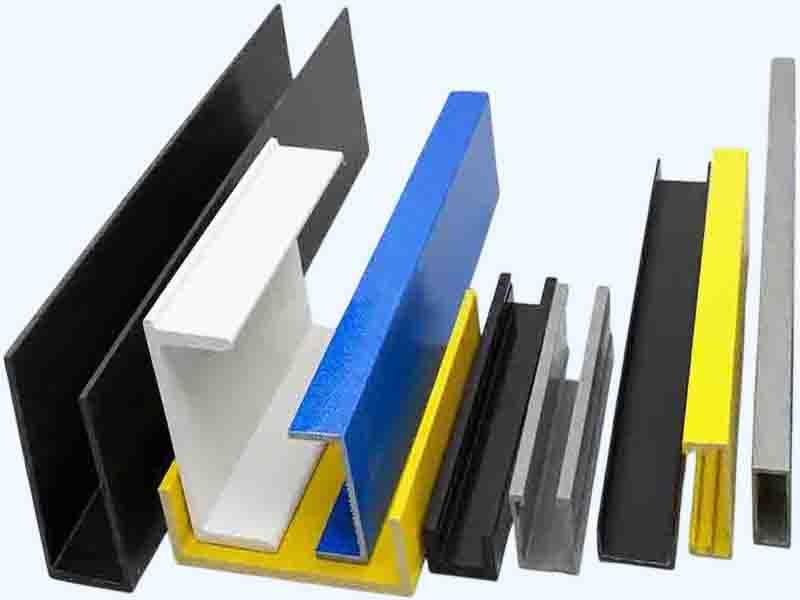
FRP channels feature a single-sided open cross-section ideal for cable tray supports, guide rails, and secondary framing where access from one face is required. Pultruded FRP channels deliver the stiffness of steel channels at a fraction of the weight, without the corrosion-driven replacement cost.
Why the Open C-Section Works on Site
- Flange dimensions that match steel channel standards. The web depth and flange width follow conventional C-channel sizing — C3, C4, C6, and C8 profiles are standard. That means an FRP channel drops into the same bracket spacing and bolt patterns designed for steel. For a retrofit in a water treatment gallery or a chemical plant cable tray run, there's no need to redraw the support spacing.
- Single-sided access speeds up assembly and inspection. With one open face, bolts go in from the open side without needing to reach around both flanges. This is a genuine advantage when installing grating support stringers or equipment guide rails in tight spaces — the installer can position the fastener and tighten it from the same side, without awkward angles or blind reaches.
- Weight that a single person can manage overhead. At roughly one‑quarter the weight of an equivalent steel channel, a 3‑metre length can be lifted, positioned, and bolted by one installer. In a congested cable basement or a pipe rack with limited lifting clearance, that single‑person handling eliminates the need for rigging equipment and extra crew.
- Corrosion resistance without coating maintenance. Steel channel in a coastal plant or chlorine building is on a timer — the galvanising erodes, the paint blisters, and section loss follows. FRP channel in vinyl ester resin has no coating to fail. The entire cross-section is inherently resistant to moisture, salt, and chemical fumes, top flange to bottom flange.
Common applications replacing steel channel sections:
- Cable tray longitudinal supports and cross-members
- Grating support stringers and perimeter angles
- Equipment guide rails and sliding tracks
- Electrical enclosure stiffener frames
- Secondary framing in corrosive plant areas
In every case, the FRP channel carries the same structural function without starting a corrosion clock.
Operating Parameters
| Parameter | Typical Range / Value | Notes |
|---|---|---|
| Resin options | Polyester, vinyl ester | Vinyl ester for aggressive chemical or marine environments |
| Standard sizes | C3 × 1.5, C4 × 2.0, C6 × 2.5, C8 × 3.0 (inch equivalents) | Web depth × flange width; follows steel channel conventions |
| Web depth range | 75 mm to 200 mm (3″ to 8″) | Deeper webs for longer spans or higher vertical loads |
| Flange width range | 35 mm to 75 mm (1.5″ to 3″) | Wider flanges for increased lateral stiffness |
| Wall thickness | 3 mm to 6 mm (⅛″ to ¼″) | Uniform throughout web and flanges |
| Length | Standard up to 6 m (20 ft); longer on request | Custom cut lengths available |
| Flexural modulus | Approx. 20–25 GPa (2.9–3.6 Msi) | Depends on fibre architecture and resin system |
| Maximum continuous service temperature | Polyester: 80°C; Vinyl ester: 100°C | Short‑term excursions acceptable |
| Weight | Approx. 2–8 kg/m (1.3–5.4 lb/ft) depending on size | Approximately one‑quarter of equivalent steel channel |
| Surface finish | Smooth (standard); UV veil or colour available | Additional finishes on request |
Proven in Field
"Our cable tray support channels in the chlorine building were rusting through every three years. We replaced them with FRP C-channels — same bolt spacing, same dimensions, no modifications to the existing brackets. That was over six years ago, and the channels haven't needed a single touch-up."
FRP channels are part of our FRP Structural Profiles range. See the full product family for I-beams, square tubes, round tubes, angles, solid rods, and flat bars.