
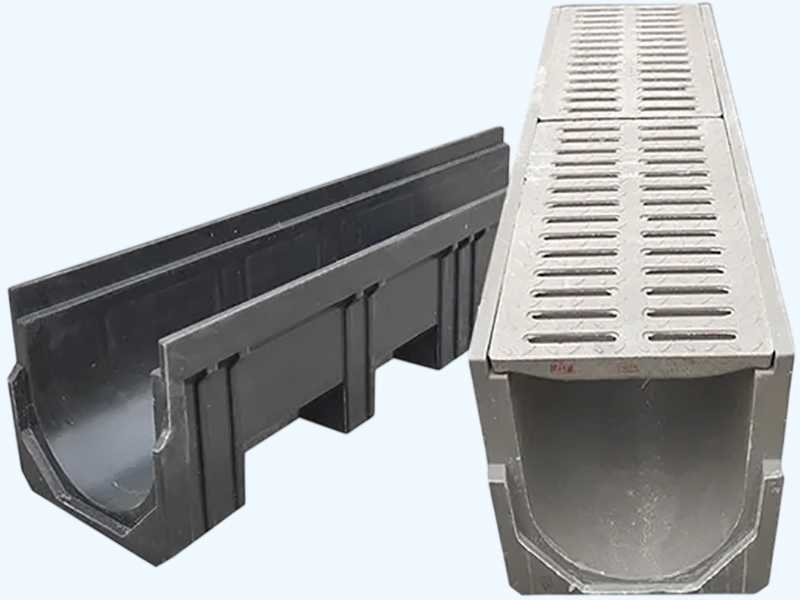
Built from corrosion‑resistant polyester or vinyl ester resin, FRP drainage channels manage acidic effluents in chemical plants and salt‑laden stormwater on coastal highways. Their smooth gel‑coat finish resists sludge buildup and maintains hydraulic flow, avoiding the progressive wall thinning that concrete and steel channels suffer over time.
In a plating line or chemical bund, a fiberglass drainage channel does more than move liquid from point A to point B. It eliminates the containment risk that corroded metal or spalled concrete introduces. The monolithic, joint‑free body removes potential leak paths at seams, and the integrally molded grating or slotted cover allows direct access for washdown. Because the resin is the same throughout, there is no coating to chip or reapply. For a FRP trench drain carrying mixed acids at elevated temperature, the channel stays dimensionally stable and chemically inert.
Hydraulic efficiency is built into the profile. The gel‑coat interior consistently measures a Manning’s n around 0.009–0.010—comparable to new steel, but one that stays constant because the surface cannot corrode or roughen. Engineers sizing corrosion resistant drainage for a chemical storage area often find they can specify a shallower, narrower channel than with concrete, saving on excavation and civil works. That shallow‑profile advantage also simplifies tie‑in to existing FRP infrastructure such as trench covers and sumps.
Standard Dimensions & Performance
| Internal width | 150, 200, 300 mm (6, 8, 12 in) |
|---|---|
| Internal depth | 200–600 mm (8–24 in), custom depths available |
| Wall thickness | 5–8 mm, uniform throughout |
| Resin system | Isophthalic polyester (standard); vinyl ester for strong acids/solvents |
| Grating cover | Molded FRP grating, slotted or solid top; load class per EN 1433 |
| Chemical resistance | pH range 1–14 (vinyl ester); pH 3–10 (polyester) |
| Temperature range | −40°C to 100°C continuous (vinyl ester); −40°C to 80°C (polyester) |
| Manning’s n | 0.009–0.010, constant over service life |
Channels are pre‑sloped in the factory, so the installation crew sets them at grade with minimal on‑site alignment. 316 stainless steel anchor brackets secure the channel to the concrete subfloor, and sections connect with a tongue‑and‑groove joint that seals with a single bead of chemically compatible adhesive. The same joint detail is used across drainage systems that combine channels, catch basins, and trench covers, simplifying the bill of materials on multi‑contractor sites.
Proven in Field
“The concrete trench drains in our nickel plating line were spalling within two years from sulphuric acid exposure. We replaced them with FRP channels of the same cross‑section. Four years later, the effluent flows at the original gradient, and there is zero measurable wall loss.”
— Excerpt from Plating Line Drainage Retrofit