
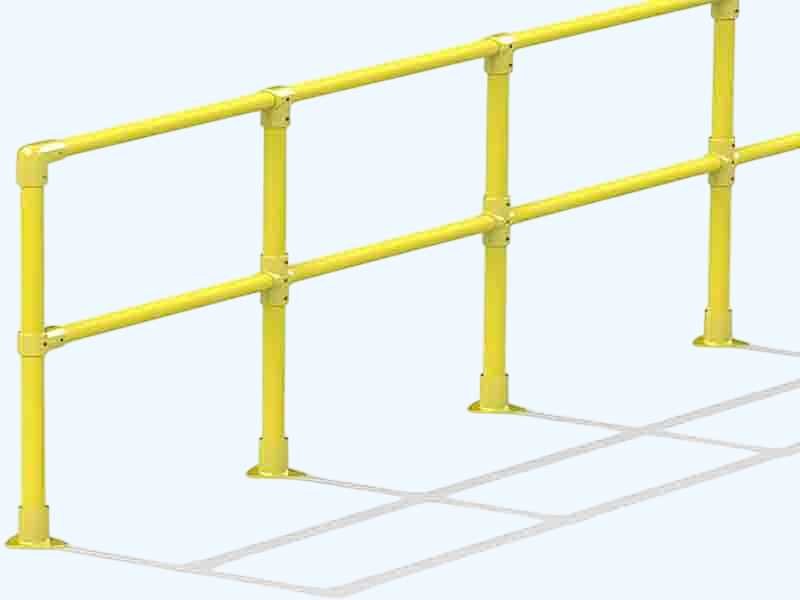
FRP handrail systems combine round and square tube profiles with modular connectors to create continuous guardrail runs around platforms, walkways, and mezzanines. The assembly uses mechanical fastening rather than welding, so installation moves fast on site without hot work permits.
What sets a fiberglass handrail apart is the complete absence of metal in the safety path. In a substation switchyard or an electrolytic cell house, a steel handrail introduces a conductive loop that can energise during a fault or induction event. An all‑FRP system removes that risk entirely. The round top rail sits at the standard 1.1 m (42 inch) height with an intermediate mid‑rail and a 100 mm toe board channel, meeting OSHA walking‑working surface requirements without any conductive path to ground.
Because the posts and rails are pultruded from the same resin system used across the FRP access components range, corrosion resistance is uniform from the base plate to the top cap. In coastal processing terminals where salt mist attacks galvanised posts within two years, the FRP handrail still passes a close‑out inspection five years later. And because the system is delivered as a pre‑cut kit, a two‑person crew can complete a 30‑metre straight run in a single shift with basic hand tools.
Kit Contents & Dimensions
| Top rail | Round tube Ø 42 mm (1.66 in), standard length 3 m or 6 m |
|---|---|
| Mid‑rail | Round tube Ø 33 mm (1.3 in), same lengths |
| Posts | Square tube 50 × 50 mm (2 × 2 in), height 1.2 m, with pre‑drilled base plates |
| Post spacing | 1.5 m (5 ft) maximum, adjustable to fit existing anchor patterns |
| Toe board | FRP C‑channel 100 mm deep, supplied in matching lengths |
| Fittings | 316 stainless steel or FRP angle brackets; fasteners in 316 SS |
| Resin system | Isophthalic polyester (standard); vinyl ester for aggressive chemical exposure |
| Fire performance | Flame spread index ≤ 25 (ASTM E‑84) |
Where the Difference Shows Up
For industrial safety handrails in high‑voltage zones, the non‑conductive property is the primary specifier. Electrical engineers value the 20 kV‑plus dielectric strength of the FRP wall, which eliminates the need for complex isolation joints. In chemical storage areas, the surface stays cool to the touch even under direct sun, and there is no paint to peel into product zones. Maintenance teams also report that a quick washdown removes chemical residue just as effectively as on stainless steel, but without the cost or the weight.
On a practical level, the modular connection system absorbs tolerance stack‑up across a long run. Posts can be shimmed at the base, and rails slide into connectors with a few millimetres of axial play before locking. That removes the frustration of exact on‑site cutting and welding that steel systems force. It also means a retrofit into an existing platform or walkway structure — such as those seen in FRP walkway systems — typically uses the same anchor bolt footprint, so there is no concrete drilling work.
Proven in Field
“We specified FRP handrails for the entire cell house rooftop after a steel rail became live during a ground‑fault test. The kit arrived labelled by section, and the crew assembled 80 metres in two days without a single hot work permit. The rails have been in place for four years with no measurable degradation.”
— Excerpt from Marine Dock Handrail Retrofit