
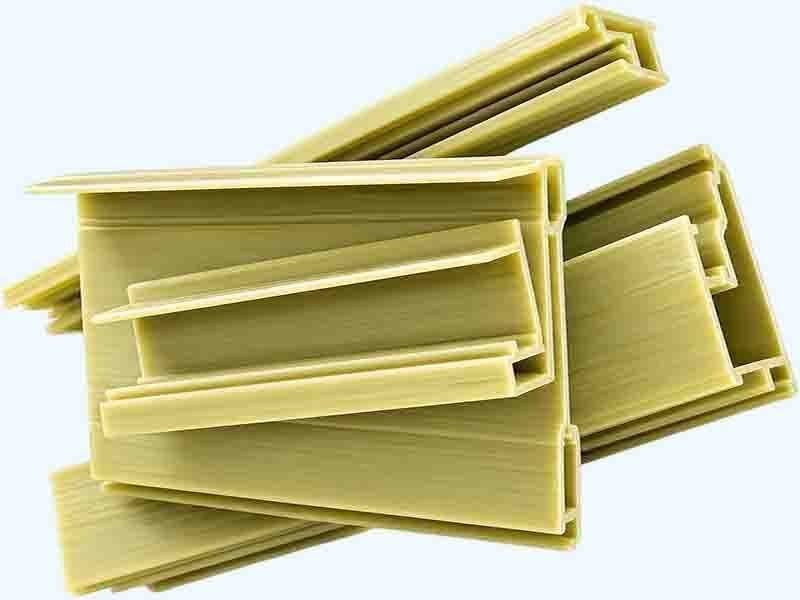
PU thermal break profiles create the insulating separation between the inner and outer aluminum shells of a curtain wall or window frame. A low‑conductivity polyurethane composite takes the place of the aluminum web, cutting heat transfer enough to meet Passive House and LEED envelope requirements without thickening the glass.
A structural thermal break profile does more than insulate—it transmits moment, shear, and axial loads across the building envelope. In a balcony connection or a parapet support, the profile sits at the thermal boundary, mechanically fastening the interior structural slab to the exterior cantilever while reducing linear thermal transmittance (ψ) to below 0.15 W/m·K. That’s an order of magnitude lower than a continuous aluminum or steel bracket, and it’s achieved without increasing the depth of the insulation layer. The load path is maintained through a series of pultruded PU‑GRP bars or profiled sections, each verified to carry the design loads in accordance with EN 1990 or AISC provisions.
For PU insulation profile applications in high‑performance envelopes, the material properties of the composite are critical. The polyurethane matrix delivers a thermal conductivity around 0.25–0.30 W/m·K, while the embedded glass reinforcement provides a tensile strength exceeding 600 MPa and a shear modulus that keeps the thermal break stiff under wind and live loads. The combination means the profile can be detailed as a standard structural element in finite‑element models, with documented modulus and creep behaviour. Architects and envelope consultants use composite thermal barrier sections at canopy attachments, roof‑screen supports, and curtain‑wall mullion transitions—anywhere a point connection would otherwise pierce the insulation layer and create a condensation risk.
Profile Specifications & Thermal Data
| Profile construction | Pultruded PU‑GRP composite; solid or hollow sections with integral fiber reinforcement |
|---|---|
| Thermal conductivity (λ) | 0.25–0.30 W/m·K (EN 12667 / ASTM C518) |
| Linear thermal transmittance (ψ) — typical detail | 0.08–0.15 W/m·K, depending on section depth and connection geometry |
| Tensile strength | ≥ 600 MPa (87 ksi) longitudinal (ASTM D638) |
| Shear strength | ≥ 20 MPa (2.9 ksi) at PU‑metal interface |
| Modulus of elasticity | ≥ 40 GPa (5.8 Msi) |
| Density | 1,200–1,400 kg/m³ |
| Section depths | 40–120 mm (1.6–4.7 in), depending on load and ψ target |
| Fire rating | Flame spread index ≤ 25 (ASTM E‑84); Euroclass C‑s1,d0 available |
Profiles are fabricated to project‑specific lengths and can be pre‑drilled for bolted connections to the structural slab and the exterior element. Thermal break modules are typically combined with stainless‑steel reinforcement in the compression zone where moment reversal demands it, but the bulk of the section remains thermally efficient. These components integrate seamlessly with the broader PU composite profiles family—window and door frames—so the entire building envelope shares a consistent thermal and structural specification. The section design also references the same load paths described in structural support systems, ensuring that the thermal break doesn’t introduce an unverified link in the structural chain.
Proven in Field
“The balcony connections on our 12‑storey residential tower were originally detailed with steel brackets, causing condensation and heat loss complaints from top‑floor units. We retrofitted the connections with PU thermal break profiles. Post‑retrofit thermography showed a 12°C rise at the slab‑edge, and the occupants reported no further condensation through two full winters.”
— Excerpt from Building Envelope Thermal Retrofit Study