
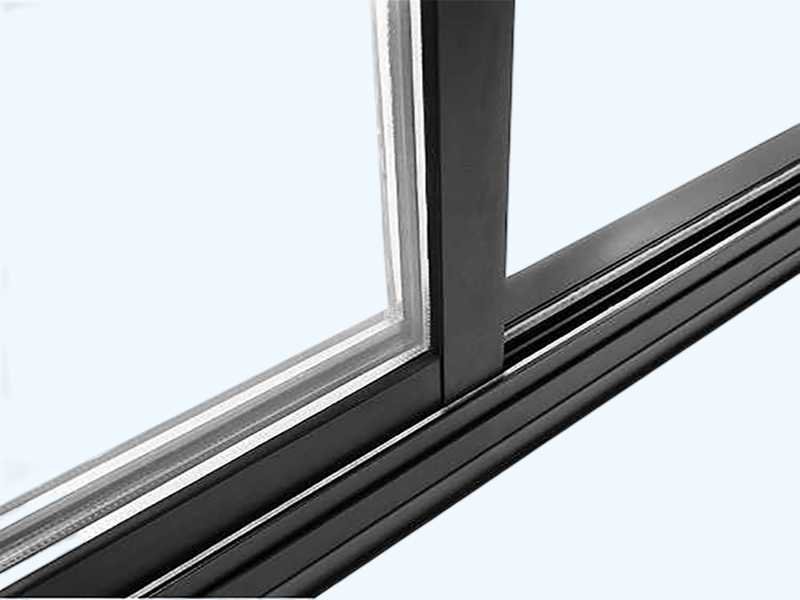
PU composite door profiles bring the same thermal break principle to commercial entrance doors, where higher traffic and heavier panels demand greater stiffness. The profile cross-section is engineered to resist the racking forces that door frames experience through thousands of open-close cycles.
A polyurethane door frame profile does two things at once: it stops heat migrating through the frame from the warm side to the cold side, and it provides the structural spine that carries a heavy commercial door leaf without sagging. The core is a high‑density polyurethane foam, typically 120–180 kg/m³, reinforced with continuous glass fiber rovings. The combination yields a thermal conductivity below 0.30 W/m·K through the section while delivering a flexural modulus that keeps the corner joints square season after season. For a thermal break door profile in a passive house or a cold‑climate entryway, that U‑value contribution can be the difference between hitting the building envelope target and needing compensatory insulation elsewhere.
The surface of an insulated door FRP profile carries a UV‑stabilized gel‑coat or a paintable polyurethane skin. Either finish accepts architectural top coats without priming, so the door system can match the window frames and curtain walling on the same elevation. That matters in commercial entrance systems where the architect wants a uniform thermal break across all openings. The profile is available in standard door‑frame depths—70 mm, 80 mm, and 100 mm—with a wall thickness calibrated to accept multi‑point locks, concealed closers, and threshold seals. Because the PU composite does not absorb moisture, there is no swelling or sticking at the door edges during wet seasons, a persistent complaint with timber frames in high‑traffic vestibules.
Profile Specifications & Thermal Performance
| Profile type | Pultruded PU‑GRP hybrid, hollow or foam‑filled |
|---|---|
| Frame depths | 70, 80, 100 mm (2.8, 3.1, 3.9 in) |
| Thermal conductivity (λ) | ≤ 0.30 W/m·K through the cross‑section (EN 12667) |
| U‑value (typical 80 mm frame) | 0.9–1.3 W/m²·K depending on glazing interface and gasket design |
| Flexural modulus | ≥ 20 GPa (2.9 Msi) longitudinal |
| Density (core) | 120–180 kg/m³ polyurethane foam |
| Surface finish | UV‑stabilized gel‑coat or paintable PU skin; RAL colour matching available |
| Hardware compatibility | Accepts standard multi‑point locks, concealed closers, and threshold seals |
| Fire rating | Flame spread index ≤ 25 (ASTM E‑84); Euroclass C‑s1,d0 achievable |
Frames are fabricated from cut‑to‑length profiles using standard PU‑compatible adhesive or mechanical corner cleats. No welding or metal‑to‑metal bridging is required, so the thermal break remains continuous from the threshold to the head. The profiles integrate into the wider PU composite profiles family—window frames, thermal break connectors, and façade mullions—allowing the entire building envelope to share a single thermal‑performance specification. For applications where the door frame must also carry structural loads beyond its own leaf weight, the profiles can be designed into the same load path as structural support systems that use composite framing members.
Proven in Field
“The multi‑family development had a passive house target and the entrance doors were the last remaining thermal bridge. We specified PU composite door frames with an 80 mm depth. The blower‑door test came back at 0.45 ACH, comfortably below the 0.6 ACH threshold, and the frames have shown zero warping or sticking through three heating seasons.”
— Excerpt from Passive House Entrance System Study