
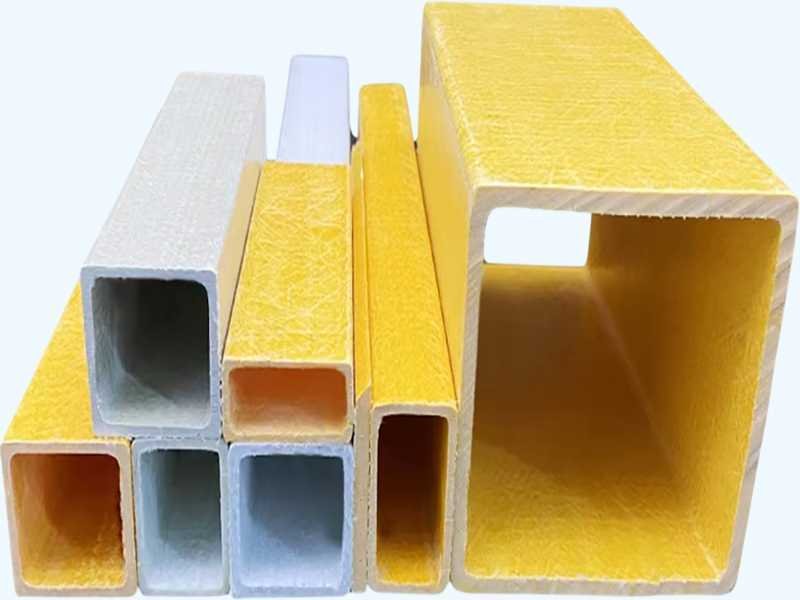
FRP square tubes offer balanced multi-directional load capacity in a symmetrical cross-section that simplifies connections and framing. Commonly used for guardrail posts, equipment stands, and structural columns in corrosive atmospheres, pultruded square tubes provide uniform stiffness without the maintenance burden of coated steel.
Why the Square Hollow Section Works
- Symmetry that simplifies every connection. A square cross-section gives you the same section modulus in both axes, so the tube behaves predictably whether the load comes from the side, the front, or at an angle. For fabricators, this means end plates, base plates, and splice connections follow the same layout on all four faces — no need to track orientation during assembly.
- Hollow, so weight stays low while stiffness stays high. The closed box section resists torsion far better than an open profile like an angle or channel. At the same time, the hollow core keeps the weight per metre at roughly one-quarter of an equivalent steel square tube. On a long cable tray support run or a mezzanine handrail system, that weight difference accumulates across hundreds of linear metres.
- Consistent wall thickness, predictable strength. Standard wall thicknesses of 3 mm and 5 mm run uniformly through the entire length of every tube. No thin spots at corners, no variation from batch to batch. Engineers sizing these sections for guardrail posts or equipment support legs can rely on the published section properties without adding the safety factors that variable-quality materials demand.
- Corrosion resistance built into the resin, not painted on. In a chemical plant, wastewater treatment facility, or coastal installation, a galvanised steel tube is a temporary solution. The zinc layer sacrifices itself over time, and once it's gone the base steel corrodes rapidly. FRP square tubes in vinyl ester resin don't rely on a coating — the entire wall thickness is inherently resistant to moisture, salt, and a wide range of chemicals.
Common applications replacing coated steel:
- Chemical plant guardrail posts
- Equipment stands and machine frames
- Cable tray support structures
- Non-metallic mezzanine columns
- Water treatment platform legs
Each demands stiffness without the corrosion maintenance of coated steel.
Operating Parameters
| Parameter | Typical Range / Value | Notes |
|---|---|---|
| Resin options | Polyester, vinyl ester | Vinyl ester for aggressive chemical or marine environments |
| Standard sizes | 25 mm × 25 mm to 150 mm × 150 mm (1″ × 1″ to 6″ × 6″) | Square cross-section; custom sizes on request |
| Wall thickness | 3 mm and 5 mm standard | Uniform throughout entire cross-section and length |
| Length | Standard up to 6 m (20 ft); longer on request | Custom cut lengths available |
| Flexural modulus | Approx. 20–25 GPa (2.9–3.6 Msi) | Depends on fibre architecture and resin system |
| Maximum continuous service temperature | Polyester: 80°C; Vinyl ester: 100°C | Short‑term excursions acceptable |
| Weight | Approx. 1–8 kg/m (0.7–5.4 lb/ft) depending on size | Approximately one-quarter of equivalent steel square tube |
| Surface finish | Smooth (standard); UV veil or colour options available | Additional finishes on request |
Proven in Field
"We replaced over 200 linear metres of corroded steel handrail posts with FRP square tubes in our chlorine building. The original steel posts lasted three years before section loss became visible. The FRP posts have been in continuous service for over six years with zero measurable degradation."
FRP square tubes are part of our FRP Structural Profiles range. See the full product family for I-beams, round tubes, angles, channels, solid rods, and flat bars.