
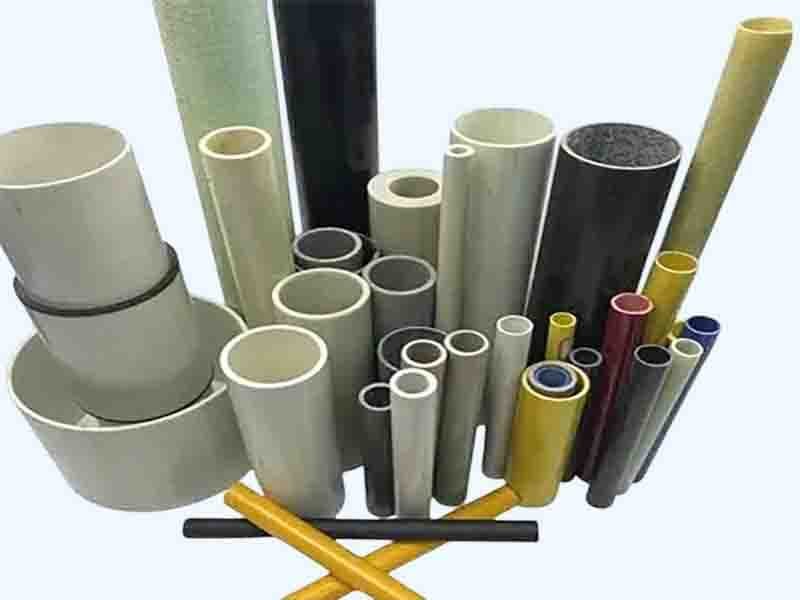
FRP round tubes combine torsional stiffness with a clean cylindrical profile suited for handrails, circular railings, and fluid-handling structural supports. The pultruded construction yields consistent wall thickness and diameter tolerances, making them a direct fit for infrastructure projects that need both durability and a neat finish.
What the Round Profile Delivers
- Diameter standards that slot into existing systems. Standard sizes follow IPS (Iron Pipe Size) conventions, so FRP round tubes drop directly into support brackets, pipe clamps, and U‑bolt hangers designed for steel pipe. For a retrofit project — replacing corroded steel pipe supports in a water treatment plant, for instance — the FRP tube arrives with the same outside diameter as the steel it replaces. No bracket modifications, no spacer rings.
- True torsional stiffness in all directions. A round cross‑section resists twisting loads equally from any angle. That matters for handrail posts that get grabbed, pulled, and leaned on from unpredictable directions, and for structural posts subject to wind loads that don't arrive neatly aligned with a square face.
- Insulating sleeve applications without compromise. Because FRP is electrically inert, round tubes serve as insulating sleeves around busbars, through‑wall penetrations for electrical conduits, and isolation sleeves on cathodic protection systems. The consistent wall thickness ensures the dielectric performance is uniform along the entire length, with no thin spots to become a breakdown path.
- Corrosion resistance that handles immersion and splash alike. In chemical dosing areas, wastewater channels, and coastal handrail systems, the tube sees moisture from all sides. Vinyl ester resin throughout the entire wall thickness means there's no coating to chip, no galvanising to wear thin, and no substrate to expose when the surface gets scratched during installation.
Common applications replacing steel pipe and tubing:
- Handrail and guardrail posts in corrosive environments
- Structural supports over chemical dosing tanks
- Electrical insulating sleeves and busbar covers
- Fluid-handling area pipe supports and stanchions
- Offshore and marine platform railings
Each application trades the corrosion clock of coated steel for a material that ignores the environment entirely.
Operating Parameters
| Parameter | Typical Range / Value | Notes |
|---|---|---|
| Resin options | Polyester, vinyl ester | Vinyl ester for chemical immersion or aggressive marine environments |
| Standard diameters | 25 mm to 300 mm (1″ to 12″ IPS) | Follows standard IPS pipe size conventions |
| Wall thickness | 3 mm and 5 mm standard; heavier on request | Uniform throughout entire cross‑section and length |
| Length | Standard up to 6 m (20 ft); longer on request | Custom cut lengths available |
| Flexural modulus | Approx. 20–25 GPa (2.9–3.6 Msi) | Depends on fibre architecture and resin system |
| Maximum continuous service temperature | Polyester: 80°C; Vinyl ester: 100°C | Short‑term excursions acceptable |
| Electrical properties | Dielectric strength > 5 kV/mm (short‑term) | Electrically inert; suitable for insulating applications |
| Weight | Approx. 1–15 kg/m (0.7–10 lb/ft) depending on diameter | Approximately one‑quarter of equivalent steel pipe |
| Surface finish | Smooth (standard); UV veil or colour options available | Additional finishes on request |
Proven in Field
"The steel handrail posts around our chemical storage tanks needed repainting every two years, and the bases were still corroding through. We swapped them for FRP round tubes five years ago. The install used the same base flanges, and the posts haven't needed a single maintenance intervention since."
FRP round tubes are part of our FRP Structural Profiles range. See the full product family for I-beams, square tubes, angles, channels, solid rods, and flat bars.