
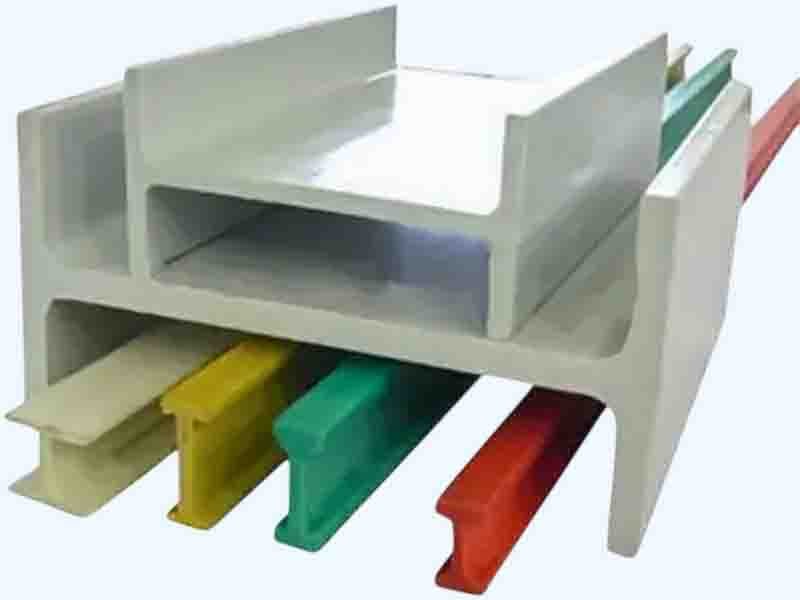
FRP I-beams are pultruded structural members designed for flexural load applications where corrosion resistance and a high strength-to-weight ratio matter. Available in standard flange widths and web depths, they serve as primary load-bearing elements in chemical plant framing, pedestrian bridges, and offshore platform support structures.
What the Pultruded I-Section Brings to Structural Framing
- Direct dimensional replacement for steel I-sections. The flange widths, web depths, and overall geometry follow standard steel I-beam conventions — W4, W6, W8, and W10 profiles are all available. This means an engineer specifying FRP doesn't need to redesign the connection details from scratch. Bolt holes, splice plates, and bearing seats all follow familiar dimensional logic.
- Weight that changes the installation equation. At roughly one-quarter the weight of an equivalent steel section, a 6-metre FRP I-beam can be carried by two people without lifting equipment. On a congested chemical plant mezzanine or an offshore platform with crane access limitations, that weight difference determines whether the job takes a morning or a full shift with a rigging crew.
- Non-conductive, non-magnetic. For substation structures, MRI facility framing, and aluminium smelter walkways, the fact that FRP carries no electrical current and generates no magnetic interference isn't a feature — it's the entire reason the material is on the table. Steel simply cannot compete in these applications without elaborate isolation measures.
- Corrosion resistance without coating maintenance. In a chemical plant or coastal marine environment, a painted steel I-beam is on a maintenance clock from the day it's installed. FRP I-beams in vinyl ester resin eliminate that cycle entirely — no blasting, no priming, no topcoat, no repeat. The upfront material cost is higher, but the lifecycle arithmetic tends to close that gap within the first maintenance interval.
Typical structural applications where FRP I-beams serve as primary load-bearing elements:
- Chemical plant pipe support bents
- Pedestrian bridge primary stringers
- Offshore platform equipment support frames
- Cooling tower structural members
- Storage tank dike access platforms
Each of these shares a common requirement: carry bending loads reliably for decades in an environment that would consume steel in years.
Operating Parameters
| Parameter | Typical Range / Value | Notes |
|---|---|---|
| Resin options | Polyester, vinyl ester | Vinyl ester for aggressive chemical or marine environments |
| Standard profiles | W4 × 1.5, W6 × 2.0, W8 × 2.5, W10 × 3.0 (inch equivalents) | Follows steel I-beam dimensional conventions |
| Flange width range | 100 mm to 250 mm (4″ to 10″) | Wider flanges for higher lateral stability |
| Web depth range | 100 mm to 250 mm (4″ to 10″) | Deeper webs for longer spans |
| Length | Standard up to 6 m (20 ft); longer on request | Shipping constraints typically limit single-piece length |
| Flexural modulus | Approx. 20–25 GPa (2.9–3.6 Msi) | Depends on fibre architecture and resin system |
| Maximum continuous service temperature | Polyester: 80°C; Vinyl ester: 100°C | Short‑term excursions acceptable |
| Weight | Approx. 6–15 kg/m (4–10 lb/ft) | Approximately one-quarter of equivalent steel I-beam |
| Surface finish | Smooth (standard); grit or UV veil available | Additional finishes on request |
Proven in Field
"We used FRP I-beams to frame the entire pipe support structure above our acid dosing area. The steel beams they replaced had corroded to the point of section loss within four years. The FRP structure has been up for over seven years now — no coating, no corrosion, no deflection issues."
FRP I-beams are part of our FRP Structural Profiles range. See the full product family for square tubes, round tubes, angles, channels, solid rods, and flat bars.