
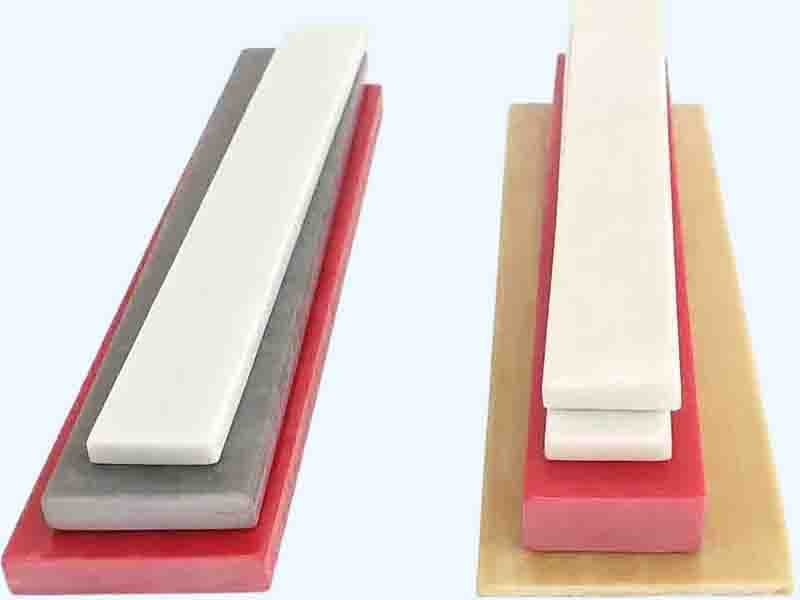
FRP flat bars provide a thin rectangular cross-section that can be easily cut, drilled, and assembled on site for spacers, connection plates, or custom-fabricated brackets. Unlike steel flat bars, pultruded FRP flat bars require no post-installation coating and stay dimensionally stable in submerged or chemically exposed conditions.
What the Flat Profile Brings to Fabrication and Service
- Width options that eliminate welding and reduce waste. Standard widths from 25 mm up to 300 mm mean a single flat bar can often replace a fabricated assembly of narrower steel strips welded together. For tank stiffener rings, chemical-resistant wear strips, or custom equipment spacers, this reduces fabrication steps and eliminates the corrosion-prone heat-affected zones that welding creates in steel.
- On-site adaptability without hot work. FRP flat bar cuts with a standard circular saw or jigsaw, drills cleanly with HSS or carbide bits, and bolts into place with conventional fasteners. On a live plant floor, this translates to shorter installation windows — a maintenance crew can measure, cut, drill, and mount a replacement stiffener inside a single shift without waiting for welding permits.
- Corrosion resistance through the full thickness. When a coated steel flat bar gets scratched during installation, the exposed steel begins corroding immediately at that point. FRP flat bar in vinyl ester resin has no coating to breach — the entire cross-section is inherently resistant to acids, alkalis, and saltwater. This is especially critical in immersion service inside chemical storage tanks, where the bar is constantly submerged and inaccessible for inspection.
- Dimensional stability in wet and chemical environments. FRP flat bars don't swell, warp, or delaminate when continuously exposed to water or chemical solutions. For tank wall stiffeners and internal baffles that must maintain precise clearances year after year, this stability matters — a swollen or corroded steel stiffener can impose unintended stresses on the tank wall itself.
Typical applications where a flat FRP section replaces coated steel:
- Tank wall stiffeners and reinforcement ribs
- Chemical-resistant wear strips and slide plates
- Equipment spacers and mounting plates
- Custom-fabricated brackets and gussets
- Submerged structural members in pickling baths
In each, the FRP flat bar does the same structural job without a corrosion clock ticking from the moment of installation.
Operating Parameters
| Parameter | Typical Range / Value | Notes |
|---|---|---|
| Resin options | Polyester, vinyl ester | Vinyl ester for immersion service or aggressive chemical exposure |
| Width range | 25 mm to 300 mm (1″ to 12″) | Custom widths available on request |
| Thickness range | 3 mm to 12 mm (⅛″ to ½″) | Thicker sections for structural stiffener applications |
| Length | Standard up to 6 m (20 ft); longer on request | Custom cut lengths available |
| Flexural modulus | Approx. 20–25 GPa (2.9–3.6 Msi) | Depends on fibre architecture and resin system |
| Tensile strength | ≥ 300 MPa (43 ksi) longitudinal | Per ASTM D638 |
| Maximum continuous service temperature | Polyester: 80°C; Vinyl ester: 100°C | Short‑term excursions acceptable |
| Water absorption | < 0.5% by weight (24h immersion) | Dimensionally stable in wet environments |
| Surface finish | Smooth (standard); UV veil or grit available | Additional finishes on request |
Proven in Field
"We replaced the steel stiffener rings inside our acid storage tanks with FRP flat bars. The old steel rings required annual inspection and frequent patching due to pitting corrosion. The FRP bars have been submerged in 20% sulfuric acid for over four years with no measurable thickness loss."
FRP flat bars are part of our FRP Structural Profiles range. See the full product family for I-beams, square tubes, round tubes, angles, channels, and solid rods.