
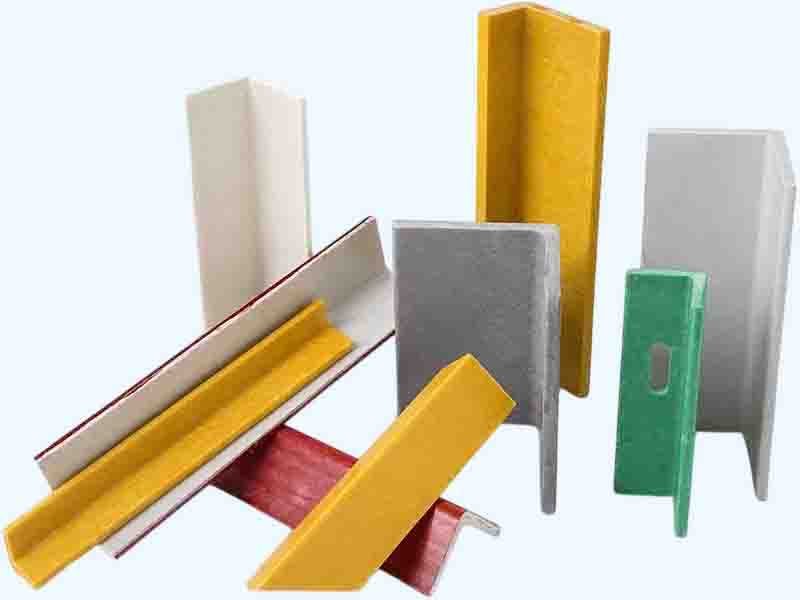
FRP angles are L-shaped pultruded profiles used for light-duty connections, edge protection, bracing, and equipment framing. Their simple geometry allows fast field cutting and drilling without hot work, cutting installation time in maintenance-heavy environments like water treatment plants.
What the L-Section Brings to On-Site Fabrication
- Equal-leg and unequal-leg options for different loading conditions. Equal-leg angles give balanced stiffness in both directions — ideal for corner connections and symmetrical brackets. Unequal-leg angles put more material along the primary load axis, useful for shelf supports and cantilever brackets where one direction dominates. Standard leg sizes range from 25 mm to 100 mm, covering most light-to-medium structural support needs without requiring a custom profile.
- Hot work eliminated from the installation sequence. On a live plant floor — above a chemical dosing tank, inside a wastewater channel gallery, or alongside operating cable trays — a hot work permit for welding or grinding adds hours of paperwork and safety precautions. FRP angle cuts with a standard circular saw or hacksaw, drills with ordinary bits, and bolts into place. The profile arrives on site, gets cut to length, and goes up within the same shift.
- Non-conductive where electrical isolation matters. In substation equipment frames, cable tray support brackets, and transformer platform stiffeners, the angle's electrical inertness is non-negotiable. Steel angle needs insulating gaskets and isolation washers to prevent stray current paths; FRP angle provides that isolation inherently, with no additional components to specify or maintain.
- Corrosion resistance that outlasts galvanised steel by multiples. A galvanised steel angle in a coastal water treatment plant or chemical storage area might give you three to five years before section loss becomes measurable. FRP angles in vinyl ester resin have been in similar service for over a decade with no measurable degradation. When the angle is buried inside a pipe rack or tank stiffener detail where inspection access is poor, that longevity matters.
Common applications replacing steel angle sections:
- Equipment support brackets and shelf angles
- Tank and vessel stiffener rings
- Cable tray and ladder rack support brackets
- Edge protection angles on platforms and walkways
- Secondary framing and bracing in corrosive atmospheres
Each trades the maintenance cycle of coated steel for a profile that goes in once and stays.
Operating Parameters
| Parameter | Typical Range / Value | Notes |
|---|---|---|
| Resin options | Polyester, vinyl ester | Vinyl ester for aggressive chemical or marine environments |
| Leg sizes | 25 mm × 25 mm to 100 mm × 100 mm (1″ × 1″ to 4″ × 4″) | Equal-leg standard; unequal-leg on request |
| Wall thickness | 3 mm to 6 mm (⅛″ to ¼″) | Uniform along both legs and entire length |
| Length | Standard up to 6 m (20 ft); longer on request | Custom cut lengths available |
| Flexural modulus | Approx. 20–25 GPa (2.9–3.6 Msi) | Depends on fibre architecture and resin system |
| Maximum continuous service temperature | Polyester: 80°C; Vinyl ester: 100°C | Short‑term excursions acceptable |
| Electrical properties | Non-conductive; dielectric strength > 5 kV/mm | Suitable for use near energised equipment |
| Weight | Approx. 0.5–4 kg/m (0.3–2.7 lb/ft) depending on size | Approximately one‑quarter of equivalent steel angle |
| Surface finish | Smooth (standard); UV veil or colour available | Additional finishes on request |
Proven in Field
"The steel shelf brackets supporting our chlorine contact tank walkway had corroded to half their original thickness. We replaced the entire set with FRP equal-leg angles in three shifts — cut, drilled, and bolted on site with no welding permits required. That was over five years ago, and the new brackets look exactly like the day they went in."
FRP angles are part of our FRP Structural Profiles range. See the full product family for I-beams, square tubes, round tubes, channels, solid rods, and flat bars.