
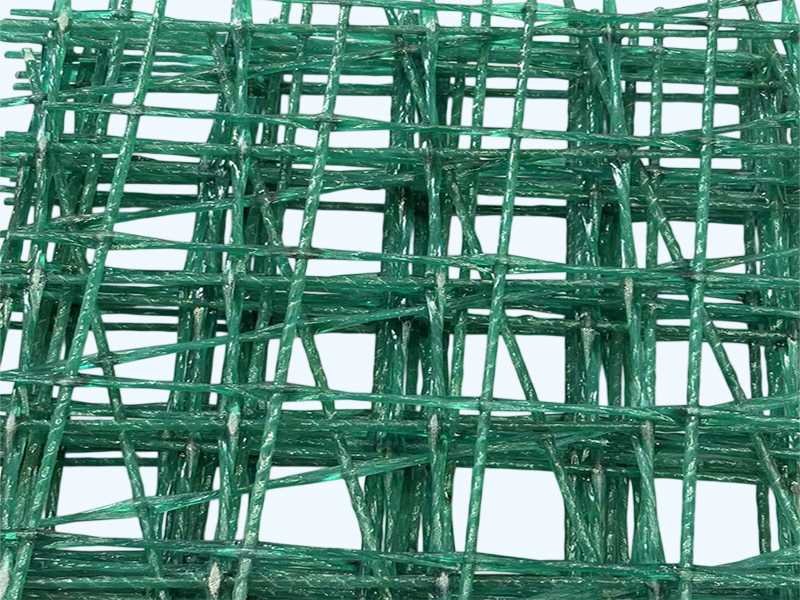
FRP rebar mesh delivers prefabricated GFRP or BFRP bar grids that roll out across slabs and tunnel linings. They also suit paved areas where rapid reinforcement placement matters. The pre‑tied intersections hold consistent spacing without the labor of tying individual bars on site.
A GFRP mesh reinforcement panel arrives on the flatbed with every intersection already welded or epoxy‑bonded under factory conditions. Bar spacing is locked to the design drawing—typically 100 mm, 150 mm, or 200 mm centres—and the grid leaves the shop with a dimensional tolerance of ±5 mm over a 6‑metre length. For a tunnel lining crew working a 24‑hour cycle, that precision means the mesh drops into the form, the shotcrete nozzle follows, and the reinforcement placement is documented without a single tie‑wire check. The panel's inherent flatness also keeps the bar cover uniform, which is a critical parameter in fiberglass rebar grid specifications for chloride‑exposed soffits and mine tunnel arches.
On the corrosion side, non‑metallic concrete reinforcing mesh solves the problem that keeps asset owners awake: mesh stored at the outer cover depth in a marine or de‑icing salt environment. Steel mesh in that position rusts, expands, and spalls the cover concrete in a predictable timeline. FRP mesh removes the corrosion reaction entirely. There is no critical chloride threshold to monitor, no anode to sacrifice, and no epoxy coating to nick during placement. For a bridge deck overlay or a sea‑wall slab, specifying FRP mesh across the full area eliminates the post‑installation corrosion monitoring line item from the maintenance budget.
Grid Specifications & Mechanical Data
| Bar type | GFRP (E‑glass/vinyl ester) or BFRP (basalt/vinyl ester) |
|---|---|
| Bar diameters | 6, 10, 13, 16 mm in both longitudinal and transverse directions |
| Grid spacing | 100 × 100 mm, 150 × 150 mm, 200 × 200 mm (4 × 4, 6 × 6, 8 × 8 in); custom spacing available |
| Panel size | Standard 2.4 m × 6 m (8 × 20 ft); custom to 3 m × 12 m |
| Tensile strength (bar) | ≥ 900 MPa (GFRP) / ≥ 1,000 MPa (BFRP) per ASTM D7205 |
| Modulus of elasticity | 45–60 GPa (GFRP) / 50–65 GPa (BFRP) |
| Intersection bond | Epoxy‑welded or filament‑wound tie; tested to retain ≥ 90% of bar tensile capacity |
| Resin system | Vinyl ester (standard); epoxy for elevated‑temperature applications |
| Weight (typical 150×150 mm, #4 bar) | Approx. 4.5 kg/m² (0.9 lb/ft²) |
Panels are lifted into place by two workers or a light telehandler. Adjacent sheets overlap by one grid spacing and are zip‑tied or clipped at the lap, with no welding or hot‑work permit required. The mesh integrates directly with the FRP reinforcement family—GFRP and BFRP rebar, couplers, and rock bolts—so the entire reinforcement schedule can be delivered as a single corrosion‑proof package. For projects that need a fully composite structural frame, the mesh is frequently combined with structural support systems in FRP, providing a reinforcement path that is non‑conductive, non‑magnetic, and immune to chloride damage from the top mat to the deepest foundation bar.
Proven in Field
“We switched from hand‑tied steel mesh to prefabricated GFRP mesh for the shotcrete primary lining in a 2‑kilometre mine access tunnel. The grid panels went in three times faster per advance, and after four years of aggressive groundwater exposure, the lining shows zero rust staining or spalling behind the mesh.”
— Excerpt from Mine Tunnel Shotcrete Reinforcement Study