
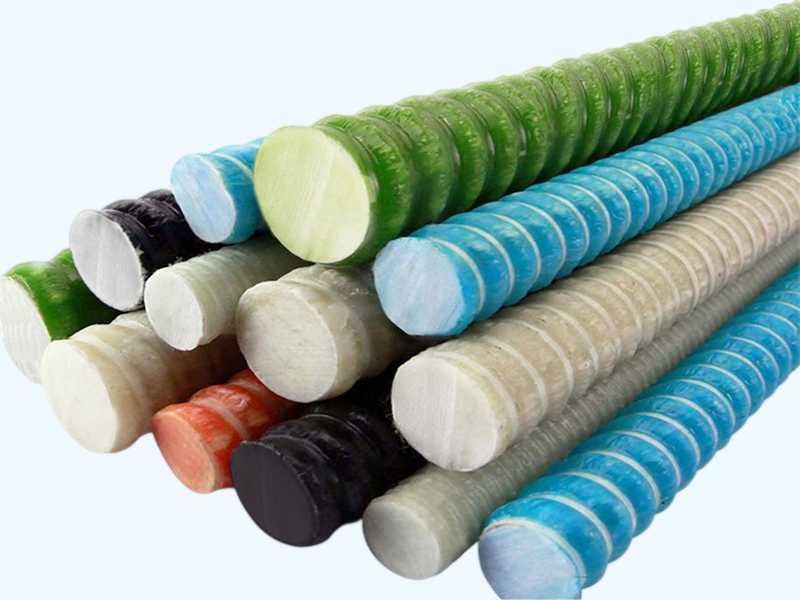
GFRP rebar serves as tensile reinforcement for concrete structures exposed to de‑icing salts and seawater. It also performs reliably in aggressive soils. At roughly a quarter the weight of equivalent steel rebar, it handles on site without lifting equipment and cuts with standard abrasive blades.
Where steel rebar corrodes, glass fiber composite rebar passes the chloride threshold test without a coating. The E‑glass or ECR‑glass fibers embedded in a vinyl ester or epoxy matrix are inherently immune to electrochemical corrosion, so there is no need for epoxy‑coatings, galvanising, or stainless‑steel alloys to achieve a long service life. In bridge decks and parking garages subject to seasonal de‑icing salts, this single property eliminates the spalling and delamination that start at the rebar mat and travel upward through the concrete cover. The result is a structure that maintains its designed concrete cover and bond strength without the periodic patching cycles that steel‑reinforced elements demand.
On the structural side, glass fiber reinforced polymer rebar delivers tensile strengths exceeding 900 MPa in the longitudinal direction, with a modulus of elasticity around 45–60 GPa. Design engineers follow ACI 440.1R for the flexural and shear design, using a guaranteed tensile strength and a creep‑rupture stress limit for sustained loads. The bar surface is typically sand‑coated or ribbed to transfer bond stresses into the surrounding concrete, and the available diameters—from 6 mm to 32 mm—cover everything from thin architectural panels to heavy mat foundations. For glass fiber rebar concrete in marine applications such as sea walls and jetties, the rebar's low magnetic permeability also makes it the specified material for MRI facilities, transformer vaults, and other electromagnetic‑sensitive structures where a steel‑free zone is mandatory.
Mechanical Properties & Dimensions
| Tensile strength | ≥ 900 MPa (130 ksi) longitudinal (ASTM D7205) |
|---|---|
| Modulus of elasticity | 45–60 GPa (6.5–8.7 Msi) (ASTM D7205) |
| Ultimate elongation | 1.5–2.5% |
| Bar diameters | 6, 10, 13, 16, 19, 22, 25, 29, 32 mm (#2–#10) |
| Surface profile | Sand‑coated, helical wrap, or integrally molded ribs for bond |
| Resin system | Vinyl ester (standard); epoxy for high‑temperature curing conditions |
| Density | 1.9–2.2 g/cm³, approximately one‑quarter of steel |
| Corrosion resistance | Immune to chloride ion attack; no critical chloride threshold |
| Thermal expansion | 6–10 × 10⁻⁶/°C (longitudinal), close to concrete |
Standard lengths are 6 m or 12 m, with custom lengths available. Bars are bundled and labelled by diameter and lot for traceability from the pultrusion line to the job site. They integrate with the same FRP reinforcement product family—couplers, rock bolts, and mesh—so the entire reinforcement package can be specified as a single non‑corrosive system. For design guidance, the bars are frequently tied into the same load path as structural support systems that use FRP framing, creating a fully non‑metallic superstructure from foundation to handrail.
Proven in Field
“The bridge deck reinforced with GFRP bars showed zero corrosion‑related cracking after five winters of de‑icing salt exposure. The previous steel‑reinforced deck on the same crossing required patching every two years, so the elimination of that maintenance alone offset the initial material cost.”
— Excerpt from Bridge Deck GFRP Reinforcement Study