
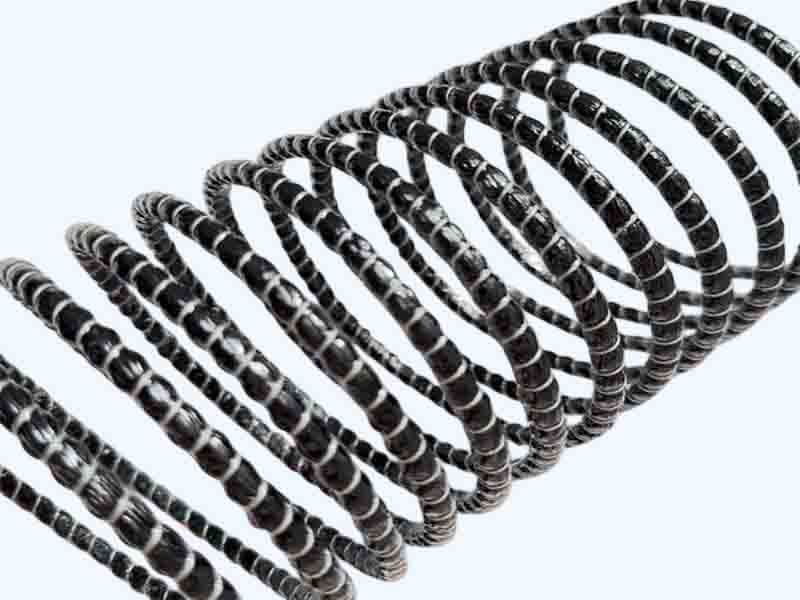
BFRP rebar uses basalt fiber reinforcement to deliver high thermal and alkaline resistance. It suits concrete exposed to elevated temperatures or chemically aggressive ground conditions where long‑term durability margins matter.
A basalt fiber composite rebar bar starts with continuous basalt roving drawn from a single‑source volcanic rock melt—no additives, no recycled glass. The fiber chemistry yields a softening point above 800°C, higher than conventional glass fiber, which directly extends the bar's service temperature. When embedded in a vinyl ester or epoxy matrix, the composite withstands sustained exposure to alkaline pore solutions that degrade lower‑grade glass fibers over decades. For basalt rebar specified in geopolymer concrete or refractory slabs, this thermal buffer and alkali resistance can remove the need for additional protective coatings or increased cover depth.
Mechanically, basalt fiber reinforced concrete reinforcement matches or exceeds the tensile performance of standard glass‑based FRP bars. Tensile strengths routinely reach 1,000 MPa or more, with an elastic modulus around 50–65 GPa—the higher end of the FRP rebar spectrum. The bar surface is sand‑coated or ribbed to transfer bond stresses, and the density at roughly 2.0–2.2 g/cm³ keeps the bar weight at about one‑quarter of steel. For structures that demand a fully natural mineral fiber source on environmental or certification grounds, the mined‑basalt supply chain provides a traceable, single‑origin raw material that synthetic fibers cannot match on documentation.
Mechanical Properties & Dimensions
| Tensile strength | ≥ 1,000 MPa (145 ksi) longitudinal (ASTM D7205) |
|---|---|
| Modulus of elasticity | 50–65 GPa (7.3–9.4 Msi) (ASTM D7205) |
| Ultimate elongation | 1.8–2.5% |
| Bar diameters | 6, 10, 13, 16, 19, 22, 25 mm (#2–#8) |
| Surface profile | Sand‑coated or integrally wound helical rib for bond |
| Resin system | Vinyl ester (standard); epoxy for elevated‑temperature or chemical exposure |
| Density | 2.0–2.2 g/cm³, approximately one‑quarter of steel |
| Softening point (fiber) | > 800°C (1,470°F) |
| Alkali resistance | Excellent; basalt fiber retains tensile capacity in pH > 12 pore solutions |
| Thermal expansion | 6–8 × 10⁻⁶/°C (longitudinal), close to concrete |
Bars ship in standard 6 m or 12 m lengths, bundled and labelled by diameter and production batch for full traceability from the melt to the site. BFRP rebar integrates seamlessly into the wider FRP reinforcement package—alongside GFRP rebar, couplers, and mesh—allowing the entire reinforcement schedule to be specified as a single non‑corrosive family. For design reference, the bars are compatible with ACI 440.1R provisions and can be detailed into the same load paths as structural support systems that use composite framing.
Proven in Field
“The BFRP‑reinforced foundation slab in our geothermal plant has now seen five years of continuous exposure to ground temperatures above 60°C and alkaline soil water. There is zero evidence of micro‑cracking or bond degradation, and the slab surface remains as placed.”
— Excerpt from Geothermal Plant Foundation Slab Study