
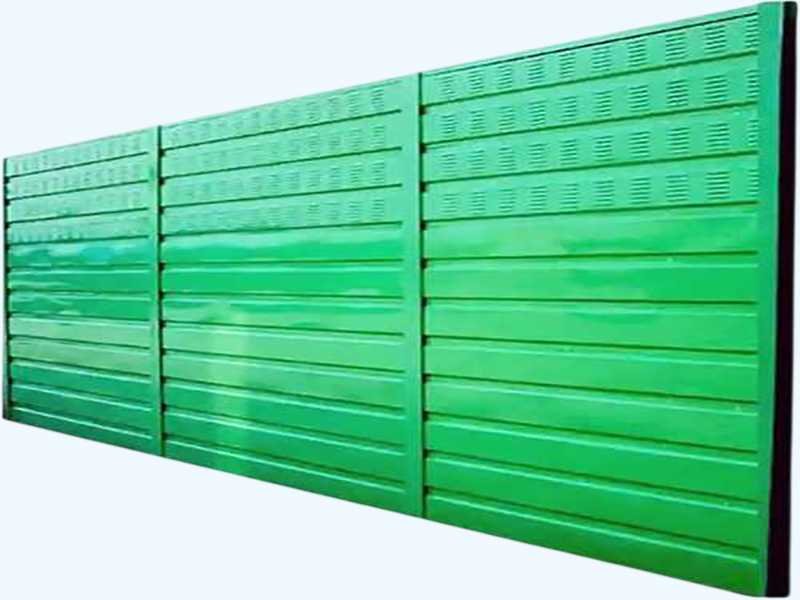
FRP sound barrier panels absorb traffic and rail noise along highways and high-speed corridors. The composite construction withstands UV, rain, and vibration without the cracking and spalling that plague precast concrete barriers after freeze-thaw cycles.
A fiberglass noise barrier works on two fronts: the dense FRP shell blocks direct sound transmission, while the perforated inner face—backed by an encapsulated mineral wool or fibre‑reinforced absorber—traps incident noise and converts it to negligible heat. The combination routinely delivers sound transmission loss ratings above 30 dB and noise reduction coefficients in the 0.75–0.90 range. For a roadside community or a trackside residential block, that means the difference between a constant low‑frequency hum and a perceptible drop in ambient noise. Because the outer shell is a single laminate without joints or porous concrete, the acoustic performance does not degrade when the panel saturates in heavy rain—unlike absorptive concrete products that rely on open‑pore structure.
The structural case for FRP acoustic panels on gantry‑mounted barriers is similarly practical. At roughly 15–25 kg/m², a panel weighs less than half of an equivalent precast concrete unit. This directly reduces the tonnage of structural steel required for support columns, cross‑beams, and foundations. In coastal zones where wind loads already drive up the steel demand, that panel‑weight saving cascades into smaller footings and shorter pile depths. For highway noise dampening retrofit projects, the lightweight panels can often be mounted on existing gantry frames without strengthening works, compressing both the engineering approval cycle and the installation window.
Panel Specifications & Acoustic Performance
| Panel construction | Solid FRP outer shell with perforated inner face; encapsulated acoustic absorber core |
|---|---|
| Standard panel size | 3 m × 1.5 m (10 ft × 5 ft); custom lengths to 4 m available |
| Thickness | 75–120 mm (3–4.7 in), depending on target NRC and STL |
| Sound Transmission Loss (STL) | ≥ 30 dB (ASTM E90) |
| Noise Reduction Coefficient (NRC) | 0.75–0.90 (ASTM C423) |
| Surface finish | UV‑stabilized gel‑coat; colour integral through the outer laminate |
| Resin system | Isophthalic polyester with UV inhibitors; vinyl ester for extreme chemical or de‑icing salt exposure |
| Fire performance | Flame spread index ≤ 25 (ASTM E‑84); self‑extinguishing grades available |
| Weight | Approx. 15–25 kg/m² (3–5 lb/ft²) |
Panels are installed vertically between steel or FRP H‑beams using a tongue‑and‑groove edge detail with EPDM gaskets. The gaskets seal against flanking noise between adjacent panels and accommodate thermal expansion without stressing the laminate. A two‑person crew can set a 3‑metre panel into its guide channels in minutes with a telehandler or mobile crane. On large corridor projects, the installation rate routinely exceeds 60 linear metres per day. The panels integrate cleanly with other FRP infrastructure components such as bridge decking and drainage channels, allowing the entire wayside assembly to share a single material specification and corrosion‑resistant design life. For projects that require coordinated design across the full structural envelope, the panels can also be linked to structural support systems that carry the gantry steelwork.
Proven in Field
“The precast concrete sound walls along our coastal rail corridor had developed surface cracking and spalling within five winters. We replaced a 200‑metre section with FRP panels two years ago. The acoustic readings at the nearest residential receiver actually improved by 2 dB, and the lighter panels let us reuse the existing gantry columns without reinforcement.”
— Excerpt from Coastal Rail Noise Abatement Project