
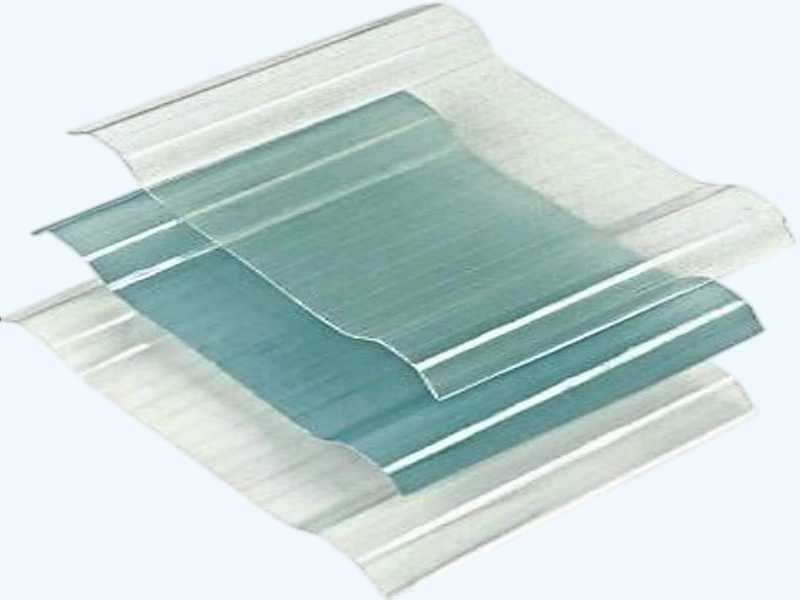
FRP roofing sheets offer a corrugated, lightweight alternative to metal roofing in chemical storage buildings and wastewater treatment sheds. Fire-retardant resin grades meet BS 476 Class 1, and the natural translucency reduces daytime lighting energy use.
A fiberglass roofing panel serves two functions that industrial buildings rarely get from a single material: it lets in diffused daylight while keeping corrosive fumes out of the roof structure. The polyester or vinyl ester matrix is chemically inert to the acidic vapours and hydrogen sulphide that turn metal roof sheets into perforated scrap within a few operating seasons. At the same time, the panel's translucency—typically 60–85% light transmission depending on the pigment load—means a chemical warehouse can operate much of the day shift without artificial lighting. That combination of corrosion resistance and daylighting is why translucent FRP sheets appear in the specifications of so many process buildings, from chlorine storage to composting halls.
On the structural side, FRP corrugated roofing follows the same trapezoidal or sinusoidal profile as metal sheeting, so it laps onto standard purlin spacings and accepts the same fixings. The difference is weight: at roughly 4–6 kg/m², an FRP sheet is about half the mass of an equivalent steel sheet, which reduces the dead load on the frame and simplifies handling during installation. A single operative can carry a 3‑metre sheet up a ladder without assistance. The corrugations provide longitudinal stiffness for normal wind and snow loads, and the material's fatigue resistance under cyclic wind loading means fewer fastener‑loosening call‑backs compared to lightweight metal roofs in exposed locations.
Sheet Specifications & Performance Data
| Profile | Trapezoidal (standard) or sinusoidal; matches common metal roof profiles |
|---|---|
| Standard sheet size | 1.1 m wide × 3 m or 6 m long (3.6 ft × 10 or 20 ft); cut‑to‑length available |
| Thickness | 1.5–3.0 mm (0.06–0.12 in) |
| Light transmission | 60–85% (clear); 20–40% (tinted); measured per ASTM D1494 |
| Fire rating | BS 476 Class 1 / Class 0 (fire‑retardant grades); ASTM E‑84 FSI ≤ 25 |
| Resin system | Isophthalic polyester with UV‑stabilized surface veil; vinyl ester for aggressive chemical atmospheres |
| Tensile strength | ≥ 80 MPa (11.6 ksi) longitudinal (ASTM D638) |
| Weight | Approx. 4–6 kg/m² (0.8–1.2 lb/ft²) |
| Temperature range | −40°C to 100°C continuous |
Installation uses standard self‑drilling fasteners with EPDM sealing washers through the crown of the corrugation. Side laps and end laps follow the same minimum overlap as metal roofing—typically 1.5 corrugations and 150 mm respectively—so the panel integrates into a hybrid roof without custom flashings. For facilities that already use FRP infrastructure for drainage channels and trench covers, adding FRP roofing creates a fully corrosion‑resistant building envelope. The sheets also complement structural support systems when the roof purlins are designed as part of a wider FRP or composite frame.
Proven in Field
“The metal roof over our chemical storage shed had rusted through in less than four years from chlorine dioxide fumes. We replaced it with FRP roofing sheets and saw an immediate improvement—the building interior now has natural daylight, and after three years there is zero visible corrosion on the panels or fasteners.”
— Excerpt from Chemical Storage Roof Replacement