
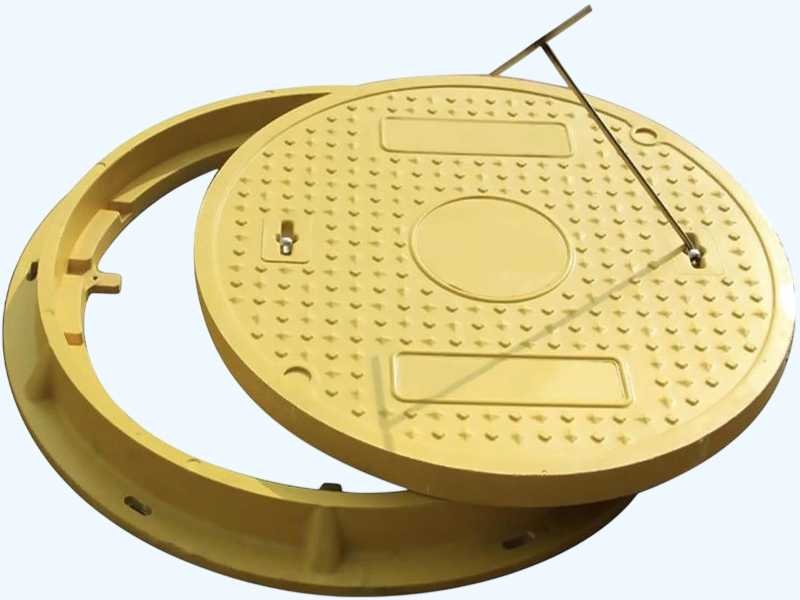
FRP manhole covers provide access to sewer chambers, valve pits, and inspection points with a lid that won't spark, won't corrode from hydrogen sulfide, and won't conduct stray electrical currents. Load ratings follow EN 124 classifications for pedestrian and light vehicle traffic.
What makes a fiberglass manhole cover a direct replacement for cast iron is not just the weight saving—it’s the complete absence of scrap value. In remote sewer networks and unmanned pumping stations, cast iron lids disappear. An FRP cover removes the incentive for theft while still meeting the load class for the location. For non‑metallic access covers in hydrogen sulfide‑rich environments, the material advantage is just as decisive: there is no iron to convert to ferrous sulfide, no concrete matrix to spall from acid attack. The cover remains dimensionally stable and crack‑free through years of exposure to biogenic H₂S above the water line.
These FRP chamber covers are molded as a single piece with integral stiffening ribs on the underside. A grit‑coated top surface provides slip resistance in wet conditions without the need for additional inserts. The standard range starts at 600 mm diameter, scaling up to rectangular formats for larger valve chambers. Because they are non‑conductive, electrical utilities specify them for transformer pit access and cable joint chambers in substations—eliminating the bonding and grounding measures that a metal lid would require. The same resin system carries through from the FRP infrastructure product family, so the cover material is chemically compatible with FRP chamber rings and linings, avoiding any galvanic mismatch at the seating face.
Dimensions & Load Classes
| Diameter (round) | 600, 675, 800, 1,000 mm (24, 27, 31, 39 in); custom diameters available |
|---|---|
| Rectangular sizes | 900 × 600 mm, 1,200 × 800 mm, and other combinations on request |
| Clear opening | Typically 50 mm less than cover diameter to suit standard frame seats |
| Load class (EN 124) | A15 (pedestrian), B125 (light vehicles), C250 (slow‑moving trucks) depending on cover depth and rib design |
| Resin system | Isophthalic polyester (standard); vinyl ester for aggressive H₂S or chemical exposure |
| Surface finish | Integrally bonded silica grit (anti‑slip); gel‑coat options for UV stability |
| Weight (600 mm round) | Approx. 15 kg (33 lbs), compared to 35–45 kg for equivalent cast iron |
Installation is a direct lift‑and‑drop into an existing frame seat or a pre‑cast concrete ring. No lifting equipment is required for the common sizes—one person can remove a 600 mm cover for a quick inspection, which keeps routine sewer and valve checks on schedule. In treatment plants where trench and chamber access are part of weekly rounds, the combination of drainage systems and FRP covers removes the usual delays caused by seized metal lids or broken concrete slabs.
Proven in Field
“Every cast‑iron manhole cover in our sewer network had either been stolen or rust‑welded shut within three years. We replaced them with FRP covers three years ago—zero thefts, and the field crews can open any chamber in under a minute with a standard lifting key. The H₂S environment hasn’t touched the material.”
— Excerpt from Sewer Network Access Upgrade