
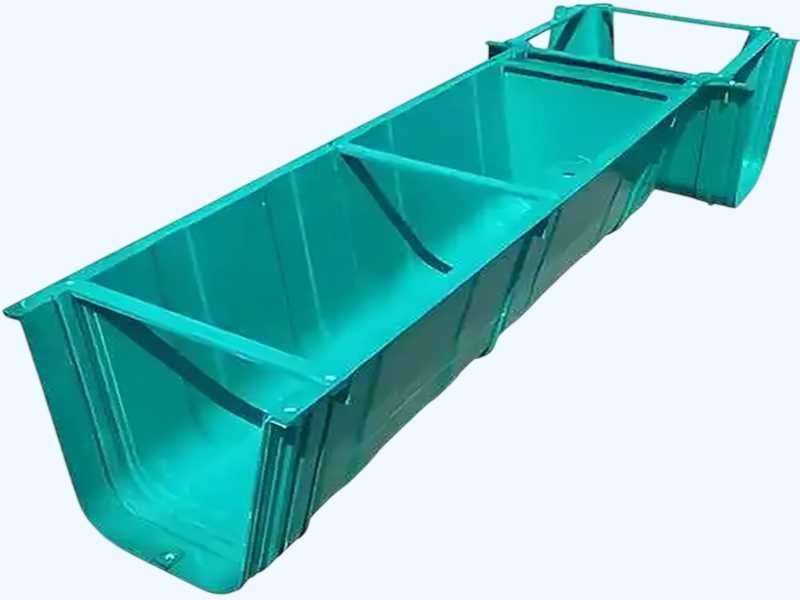
FRP irrigation channels line agricultural waterways with a smooth, UV-stable surface that resists algae buildup and soil chemicals. The modular sections connect on site without heavy machinery, cutting installation time compared to poured concrete channels.
A fiberglass irrigation flume starts with a factory‑molded shell whose inner surface is a single continuous gel‑coat, free of the trowel marks and bug holes common in poured concrete. That surface delivers a Manning's n around 0.009–0.010, which lets the design engineer specify a shallower, narrower cross‑section for the same flow rate—saving on excavation and land take. Unlike concrete linings, the FRP shell does not carbonate or react with acidic soil water, and the UV‑stabilized resin retains its gloss and hydraulic smoothness through year‑round sun exposure. For agricultural FRP water channel schemes spanning tens of kilometres, that surface consistency translates into predictable flow rates at every turnout.
On the logistics side, FRP canal lining sections ship as nesting shells that stack on a flatbed truck. A 6‑metre module weighs around 40–60 kg, light enough for two labourers to carry across a prepared earth bench without a crane. The sections join with a simple bell‑and‑spigot connection sealed with a chemically compatible adhesive or EPDM gasket, forming a watertight joint that accommodates minor ground settlement. Installation crews routinely lay 100 linear metres per day with a small team, which keeps canal‑rehabilitation shutdowns measured in weeks rather than months. The material's low thermal expansion coefficient relative to plastics means fewer expansion joints over long runs.
Channel Dimensions & Hydraulic Data
| Cross‑section | Rectangular or trapezoidal; custom profiles available for existing canal templates |
|---|---|
| Standard widths | 300, 450, 600, 900 mm (12, 18, 24, 36 in) internal base width |
| Depth | 300–1,200 mm (12–48 in); deeper sections stiffened with integral ribs |
| Section length | 3 m or 6 m (10 or 20 ft); custom to 12 m for straight runs |
| Manning's n | 0.009–0.010, constant over service life |
| Resin system | Isophthalic polyester with UV‑stabilized gel‑coat; vinyl ester for aggressive soil chemistry |
| Temperature range | −40°C to 80°C continuous |
| Weight (per metre) | Approx. 7–12 kg/m (4.7–8.1 lb/ft), depending on cross‑section |
Channels are bedded on a sand or fine‑gravel levelling course; no formwork or curing time is required. Turnout gates, offtake weirs, and check structures can be bolted directly to the channel walls using 316 stainless steel fasteners. For integrated water‑management projects, the same resin chemistry can be extended through the full FRP infrastructure scope—drainage channels, trench covers, and culvert linings—eliminating material incompatibility at structure interfaces. The system also dovetails with drainage systems where irrigation return flows or stormwater bypasses need a consistent hydraulic section.
Proven in Field
“We replaced 12 kilometres of unlined earth canal with FRP irrigation channels in a rice‑growing scheme. The water loss from seepage dropped by over 80%, and the channels have required zero relining in six seasons. The local installation crew assembled the sections without cranes, which kept the project on schedule during the dry‑season window.”
— Excerpt from Large‑Scale Irrigation Canal Retrofit