
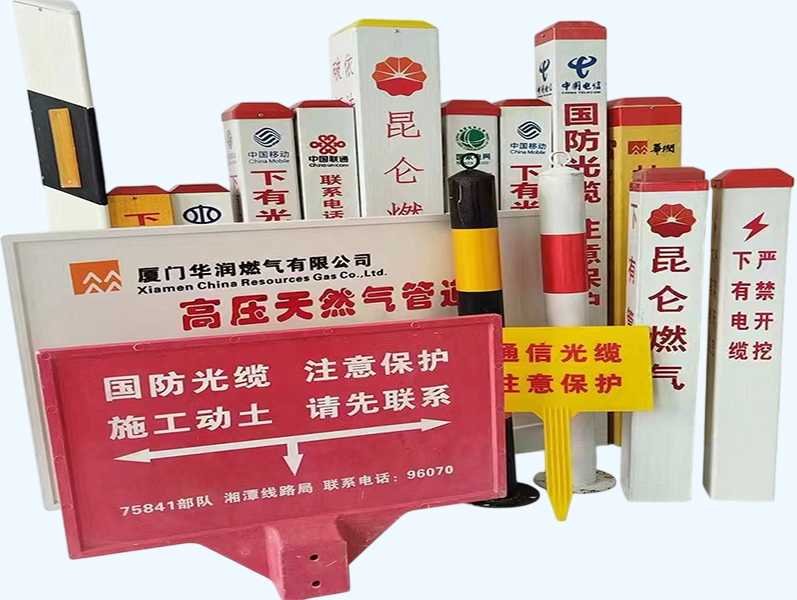
FRP marker posts identify buried utilities and pipeline routes with a weather-resistant, impact-tolerant post that takes printed or embossed labels. Unlike concrete markers, they won't crack under repeated thermal cycling, and the bright color stays visible without repainting.
We've supplied these across dozens of infrastructure projects, and the feedback is consistent: once installed, crews stop thinking about them. That's exactly what you want in a passive identification system.
What Makes an FRP Marker Post Different
The job sounds simple — mark what's underground. But the reality of long-term outdoor exposure is anything but. Sun, freeze-thaw cycles, roadside vibrations, and the occasional vehicle bump all work against a marker post over a 10- or 20-year service life. FRP handles this quietly.
- No rust, no rot. The glass-fiber-reinforced polymer matrix doesn't corrode in wet soil, salt-laden coastal air, or chemically active ground. That matters when the marker is sitting next to a gas pipeline, high-voltage cable corridor, or municipal water trunk line — environments where a steel post would be on borrowed time.
- Color that stays put. The pigment runs through the resin, not just on the surface. After five years of UV exposure, the yellow or orange is still doing its job. No repainting cycles to budget for, whether the post stands in desert sun or a damp mining site.
- Non-conductive by nature. FRP is electrically inert. For cable route marking near substations or along buried power lines, this is a genuine safety advantage — no induced currents, no grounding concerns, and no risk to crews who brush against the post while working around fiber-optic backbone routes.
- Light enough to carry, tough enough to take a hit. A single person can install these without lifting gear — a real benefit on remote pipeline rights-of-way or industrial sites where bringing in equipment is a hassle. And when a maintenance vehicle clips one at low speed, the post flexes rather than shattering. We've seen them survive encounters that would snap a concrete post clean off at the base.
Typical installation points where these posts earn their keep:
- Underground high-voltage cable corridors
- Gas and petroleum pipeline rights-of-way
- Municipal water and sewer trunk lines
- Fiber-optic backbone routes
- Mining and industrial site buried services
In all of these, the function is the same: someone on site needs to know, at a glance, what's running under their feet before they put a shovel in the ground. The marker post is the front line of damage prevention.
Marking Options: Embossed vs. Printed vs. Plate
Most projects choose one of three identification methods, and we find the decision usually comes down to budget versus permanence.
- Embossed labels are pressed into the post surface during manufacturing. The text won't fade or peel because it's physically part of the post body. For high-consequence infrastructure — gas transmission pipelines, underground high-voltage cables — this is the usual choice.
- Screen-printed legends offer more flexibility for projects that need variable information: asset IDs, phone numbers, QR codes. The print quality holds up well, though at the 10-year mark some refurbishment may be needed in extreme UV environments like open desert corridors.
- Attached aluminum or composite plates are the modular option. We see this approach on sites where the buried asset database gets updated periodically — common in large municipal sewer networks or expanding industrial complexes — and the marker needs to keep pace.
For any of these, the post itself provides the same structural backbone. A well-made FRP post with a faded label is still a working post — you just re-tag it. A cracked concrete post with a perfect label is scrap.
Proven in Field
"The markers we installed along the 11 kV cable route in 2018 haven't moved, faded, or needed a single service visit. We budgeted for annual inspection and repainting; we've done neither."
Quick Specification Reference
| Property | Typical Range | Notes |
|---|---|---|
| Material | E-glass / polyester or vinyl ester resin | Vinyl ester for aggressive chemical soil |
| Height | 1.2 m – 2.5 m above ground | Custom lengths on request |
| Wall thickness | 3 mm – 5 mm | 5 mm for high-impact zones |
| Color | Yellow, orange (standard); custom available | Through-color pigmentation |
| Labeling | Embossed, screen-printed, or plate | Embossed recommended for permanent ID |
| UV resistance | ≥ 95% color retention at 5 years (ASTM G154) | Verified on installed units |
| Operating temperature | -40°C to 80°C continuous | No embrittlement at low temperatures |
This marker post is part of our FRP Infrastructure range. See the full product line for drainage channels, trench covers, and related infrastructure solutions.