
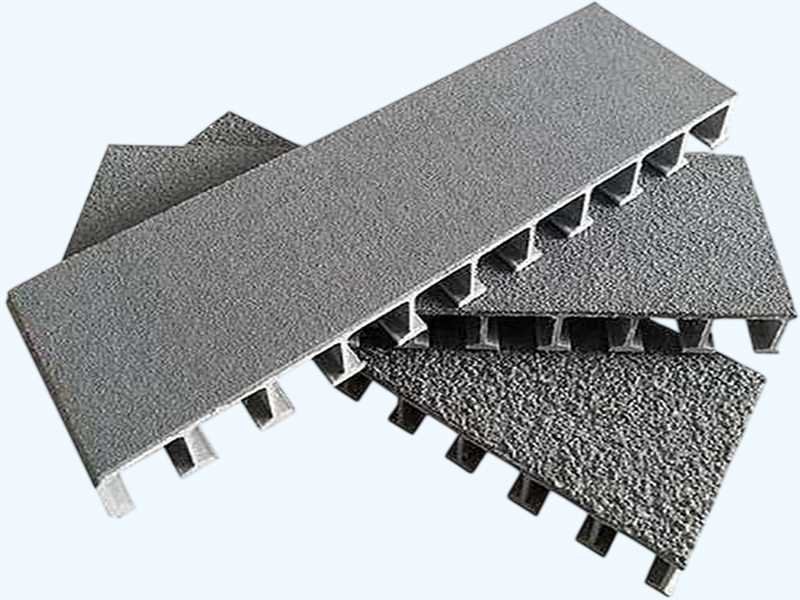
FRP bridge decking panels replace aging timber or concrete deck systems on pedestrian bridges and jetties. They also suit boardwalks where consistent section properties across long spans are essential. The pultruded profile delivers that consistency, and the grit‑bonded walking surface stays anti‑slip through years of weather exposure.
A fiberglass bridge deck earns its specification on the weighbridge before it ever reaches the site. At roughly 20–30% of the dead load of a reinforced concrete deck of equivalent span rating, an FRP panel frequently allows the existing abutments and stringers to remain in service. For a rural footbridge or a coastal jetty where foundation work would consume most of the budget, that weight saving translates directly into project feasibility. The panel's internal geometry—typically a multi‑cell box or trapezoidal rib profile—distributes wheel loads laterally, so the deck performs as a stiff plate rather than a collection of loose planks.
On a FRP pedestrian bridge deck, the walking surface is not a secondary application. The grit is bonded into the resin during pultrusion, creating a monolithic anti‑slip layer that does not delaminate under freeze‑thaw cycles or sustained UV exposure. Maintenance crews on boardwalk projects consistently report that the surface looks and performs the same after five summers as it did on day one. For composite bridge deck panels carrying light vehicles—golf carts, maintenance ATVs, occasional delivery vans—the same panel design is rated for higher axle loads by increasing the web density and panel thickness, without changing the material or the installation method.
Panel Specifications & Load Ratings
| Panel profile | Multi‑cell box or trapezoidal rib; pultruded in widths up to 1.5 m (5 ft) |
|---|---|
| Standard thickness | 50–100 mm (2–4 in), depending on span and load class |
| Span capability | Up to 3.6 m (12 ft) between stringers for pedestrian loading; shorter for vehicular |
| Pedestrian load | 5.0 kN/m² uniform, plus concentrated 3.5 kN patch — per AASHTO LRFD Guide Spec for FRP Pedestrian Bridges |
| Vehicular load | HS‑20 or HL‑93 rating achievable with engineered panel depth and support spacing |
| Surface finish | Integrally bonded silica grit, 0.8–1.0 coefficient of friction (wet and dry) |
| Resin system | Isophthalic polyester with UV package; vinyl ester for marine or de‑icing salt exposure |
| Fire performance | Flame spread index ≤ 25 (ASTM E‑84) |
| Weight | Approx. 40–70 kg/m² (8–14 lb/ft²), about 25% of reinforced concrete at the same depth |
Panels are pre‑drilled for bolted connection to steel or FRP stringers. Installation follows a simple lay‑and‑fasten sequence; a four‑person crew can close a 15‑metre pedestrian bridge span in a single day. The panels integrate with the broader FRP infrastructure package—handrail posts, drainage channels, and fascia panels—so the entire superstructure shares the same corrosion‑resistant specification. For projects that need to verify the design life, the deck panels can be tied to the same structural support systems that carry the bridge substructure, keeping the analysis consistent from abutment to handrail.
Proven in Field
“The timber decking on our coastal boardwalk was replaced twice in ten years. We switched to FRP bridge deck panels four years ago and haven’t touched them since. The grit surface still bites even when the planks are wet with sea spray, and we reused all the original piles and headstocks—the weight saving made that possible.”
— Excerpt from Pedestrian Bridge Deck Replacement