
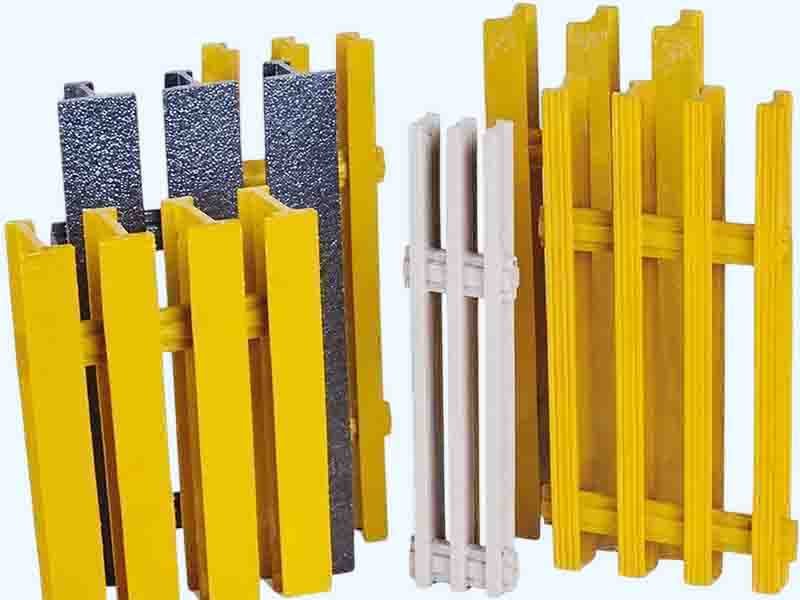
Pultruded FRP grating uses parallel, resin-saturated glass fiber bundles pulled through a heated die to form high-stiffness bearing bars. The unidirectional fiber alignment delivers superior span capability at lower weight, making it the preferred choice for long walkways and cable tray covers where dead load matters.
Pultruded FRP grating uses parallel, resin-saturated glass fiber bundles pulled through a heated die to form high-stiffness bearing bars. The unidirectional fiber alignment delivers superior span capability at lower weight, making it the preferred choice for long walkways and cable tray covers where dead load matters.
Where the Stiffness Comes From
- Fibers all pulling in one direction. Unlike molded grating with its bidirectional mat, pultruded bearing bars pack continuous glass rovings along the load path. The result is a modulus comparable to steel at a quarter of the weight. On clear spans beyond 1.2 metres, the deflection difference is immediately noticeable underfoot.
- Smooth, pedestrian-friendly surface. The standard top finish is a bonded grit layer, but the underlying bar profile is flat and even. Maintenance crews walking these walkways day after day notice the difference — no raised nodes to trip on, no ponding of chemical rinse water.
- Fewer support beams, lighter substructure. Because the panel itself carries load over longer distances, the supporting steel framework can be spaced further apart. On a large project — a wastewater treatment plant with 300 linear metres of walkway — the steel savings alone can be substantial.
- Corrosion resistance without the weight penalty. Standard polyester resin handles most industrial atmospheres; vinyl ester steps up for chlorine dioxide, sodium hypochlorite, and mixed acid fumes. Through it all, the panel weight stays roughly one-third of an equivalent steel grating.
Common installations include long straight walkways in water and wastewater plants, cable tray covers in petrochemical facilities, tunnel service gangways, and offshore platform access ways. All share the same requirement: span distance without sag, in a material that ignores moisture and salt.
Operating Parameters
| Parameter | Typical Range / Value | Notes |
|---|---|---|
| Resin options | Polyester, vinyl ester | Vinyl ester for aggressive chemical or chlorine environments |
| Bearing bar depth | 25 mm to 75 mm (1″ to 3″) | Deeper bars for longer spans or higher loads |
| Panel width | Up to 1.5 m (5 ft) standard; wider on request | Custom widths available |
| Span capability | Up to 2.4 m (8 ft) clear span (depending on bar depth & load) | Consult span tables for specific load cases |
| Surface finish | Bonded grit top (standard); smooth or custom | Grit top achieves DIN 51130 R12–R13 |
| Maximum continuous service temperature | Polyester: 80°C; Vinyl ester: 100°C | Short‑term excursions higher |
| Weight | Approx. 15–35 kg/m² (3–7 psf) | One‑third of equivalent steel grating |
Proven in Field
"We replaced 200 metres of steel walkway grating over our aeration basins with pultruded FRP panels. The lighter dead load meant we could keep the existing support steel — and after four years of constant moisture and chlorine vapour, the grating looks untouched."
Pultruded grating is part of our FRP Grating range. See how it compares to molded and heavy‑duty grating in the full product family.