
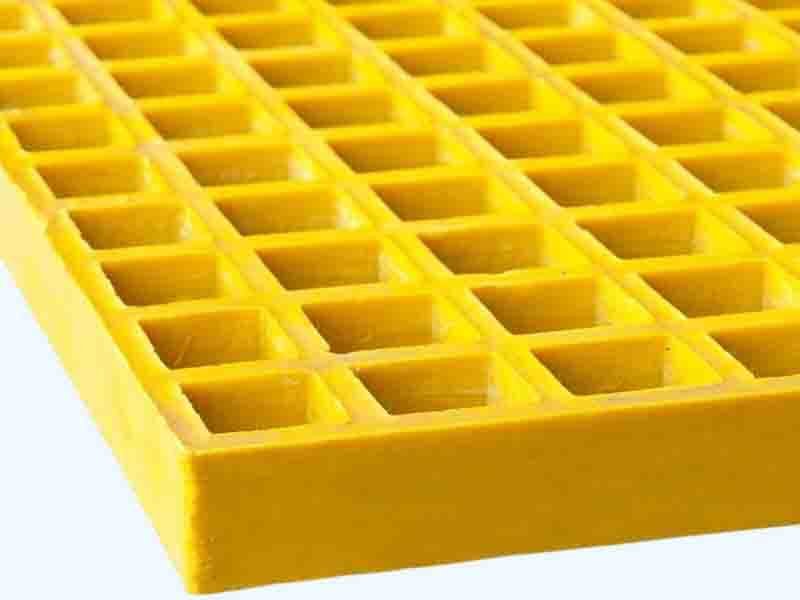
Heavy-duty FRP grating increases bearing bar depth to handle forklift traffic, truck loading zones, and heavy equipment access areas without the dead weight of equivalent steel grating. The deeper section maintains stiffness under concentrated wheel loads while keeping the overall panel weight manageable for manual handling.
Heavy-duty FRP grating increases bearing bar depth to handle forklift traffic, truck loading zones, and heavy equipment access areas without the dead weight of equivalent steel grating. The deeper section maintains stiffness under concentrated wheel loads while keeping the overall panel weight manageable for manual handling.
What the Deeper Section Delivers
- Wheel loads that would crack standard grating. A loaded forklift puts thousands of pounds onto a contact patch the size of a dinner plate. Standard 25 mm grating deflects visibly under that kind of point load — and eventually fractures at the resin-rich intersections. Heavy-duty panels use bearing bars from 50 mm up to 75 mm deep, spreading the stress through a taller section that stays well within its elastic range.
- HS-25 rating without the steel weight penalty. These panels are specified to HS-25 truck loads as standard. That means a fully laden HGV can cross without exceeding design deflection limits. Yet the panel weight is roughly one-third of an equivalent steel grating, which matters when the grating sits over a sump or trench where lifting gear access is limited.
- Corrosion resistance that survives what the vehicles drag in. Chemical plant vehicle zones don't just see the ambient atmosphere — they see road salts, hydraulic oil drips, battery acid splashes, and whatever the tyres pick up in the process area. Vinyl ester resin throughout the panel shrugs off this mixed chemical assault, top and bottom.
- Grit surface that works when wet and oily. The molded-in silica grit top delivers slip resistance even under a film of oil or chemical residue. For a loading bay or truck wash station, that's not a nice-to-have — it's the difference between a safe crossing and a reportable incident.
You'll find these panels in chemical plant vehicle access ways, shipyard loading docks, truck wash station decks, fire engine access roads over bunds, and waste treatment plant tipping areas. Each of these demands structural capacity that standard pedestrian grating simply wasn't designed to provide.
Operating Parameters
| Parameter | Typical Range / Value | Notes |
|---|---|---|
| Resin options | Polyester, vinyl ester | Vinyl ester for mixed chemical and hydrocarbon exposure |
| Bearing bar depth | 50 mm to 75 mm (2″ to 3″) | Deeper bars for longer spans or heavier wheel loads |
| Mesh size | 38 mm × 38 mm (1.5″ × 1.5″) standard | Square mesh for bidirectional load distribution |
| Panel thickness | 50 mm to 75 mm (2″ to 3″) | Substantially thicker than standard pedestrian grating |
| Design load rating | HS-25 truck loading; up to 9,000 kg (20,000 lb) axle load | Consult span tables for specific configurations |
| Surface finish | Molded-in grit top (standard) | DIN 51130 R13 achievable; oil-resistant grip |
| Maximum continuous service temperature | Polyester: 80°C; Vinyl ester: 100°C | Short‑term excursions acceptable |
| Panel weight | Approx. 45–70 kg/m² (9–14 psf) | Approximately one-third of equivalent steel grating |
Proven in Field
"Our loading dock grating used to be replaced every two years — the forklift traffic and constant chemical drips ate through steel faster than we could paint it. The heavy-duty FRP panels have been down for over five years now. Zero replacements, zero slip incidents, and the maintenance crew can lift a panel by hand when they need access underneath."
Heavy-duty grating is part of our FRP Grating range. See how it compares to standard molded and pultruded grating for different load and access requirements.