
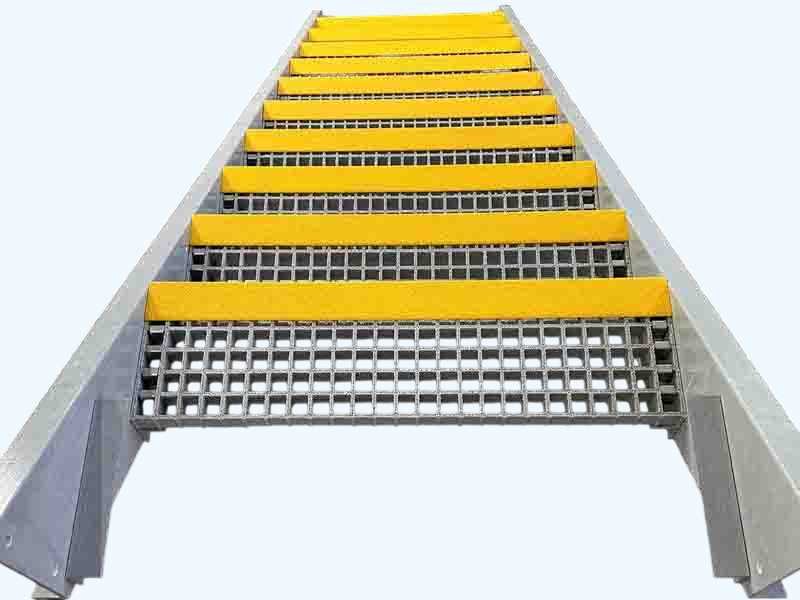
A safe flight of stairs in a corrosive industrial environment is not a nice-to-have; it’s often the only thing between a crew member and a recordable incident. This is where a FRP stair tread becomes more than a molded component—it becomes part of your site’s safety backbone.
Our fiberglass stair tread combines a pultruded FRP structural body with an integrally bonded, grit‑coated nosing. The grit is silicon carbide—one of the hardest materials you can put on a walking surface—which means the slip resistance is built into the tread itself, not a piece of tape that curls up after a season. For plants in chemical processing or coastal washdown areas, this matters. You get the same coefficient of friction under wet, oily, or highly corrosive conditions that eat through conventional steel treads in months.
Like every product in the FRP access components family, this tread is designed to drop into standard stringer profiles with minimal fuss. The 102 mm depth and nosing profile suit 45‑degree industrial stair stringers, and while the tread itself is light enough for one person to carry up a column, the glass‑reinforced structure handles point loads that would twist a typical metal checkered plate. If your site already runs FRP walkway systems, adding the matching tread keeps the corrosion‑resistance chain unbroken.
At a Glance – Typical Specs
| Depth | 102 mm (4 in) – standard for 45° stringers |
|---|---|
| Nosing | Integrally molded silicon carbide grit, >0.8 coefficient of friction (ASTM D2047) |
| Surface options | Open‑mesh grit top, or solid concave grit profile |
| Fire performance | Flame spread index ≤25 (ASTM E‑84), meeting most industrial insurance requirements |
| Resin system | Isophthalic polyester or vinyl ester for severe chemical exposure |
| Weight | Approx. 2.7 kg per linear 100 mm width (5.9 lbs) |
What Keeps Maintenance Teams Away
The value of an anti slip stair tread in FRP is as much about what you stop doing as what you start. Facilities that move away from galvanized steel treads report the same three savings: no more spot‑painting every turnaround, no more replacing treads that have rust‑jacked out of their brackets, and far fewer slip‑related near‑misses. In locations where mild steel survives less than two years, these treads are often still in service at eight. For environments that need permanent corrosion prevention without the upkeep, the material choice becomes a straightforward calculation.
Proven in Field
“After replacing steel stair treads with FRP versions across the platform, the operator recorded a 60% drop in slip incidents over two years and eliminated recurring repainting—pushing the expected tread life beyond five years.”
— Excerpt from Offshore Platform Grating Upgrade