
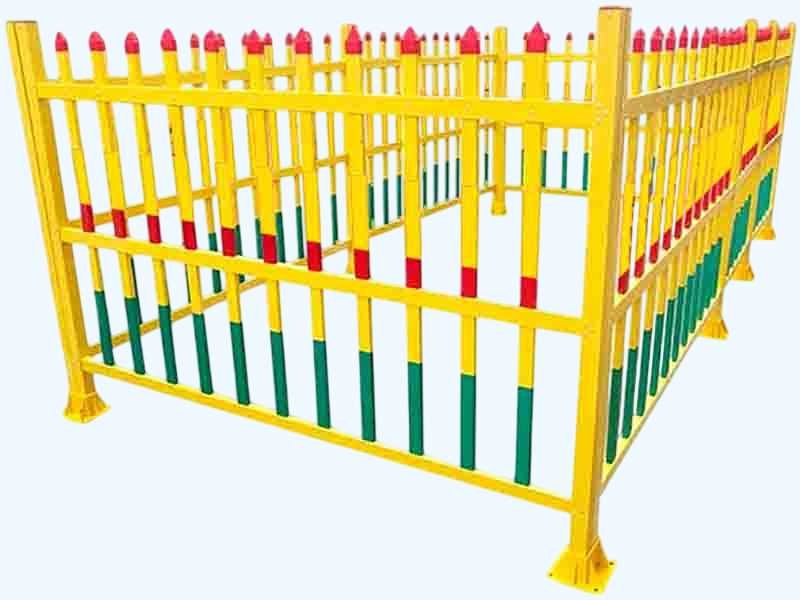
FRP fencing panels offer perimeter security and machine guarding in a lightweight format that can be cut and reconfigured on site with basic tools. They don't rust, don't need grounding, and don't block RF signals, which matters in telecom compounds and electrical substations.
A complete fiberglass security fencing system consists of interlocking pultruded panels and square‑tube posts, all fabricated from the same corrosion‑resistant resin. The panels carry a smooth, snag‑free surface on the outside and optional grit‑stippled inner face for added rigidity. Because the material is non‑magnetic and electrically inert, it eliminates the bonding and grounding calculations that steel fencing demands. In a live switchyard, that single property removes a pathway for induced currents to travel outside the designated ground grid—an outcome safety engineers value.
For industrial FRP fences in coastal or chemical storage areas, the value proposition shifts to lifecycle. Salt mist and chlorine vapour attack galvanised coatings within 18–24 months, leaving staining on concrete plinths and rust streaks on panels. FRP fencing in the same location stays visually unchanged, with no repainting or sacrificial anode replacement. A washdown with the site hose is the only recurring maintenance, and the material’s dielectric strength remains unaffected by UV exposure.
Panel & Post Specifications
| Panel construction | Pultruded square‑tube frame with internal mesh or solid infill; integrally bonded |
|---|---|
| Standard panel size | 2.4 m (8 ft) wide × 1.8 m (6 ft) high; custom heights available |
| Post section | Square tube 65 × 65 mm (2.5 × 2.5 in), 4.8 mm wall |
| Post spacing | 2.4 m (8 ft) centre‑to‑centre to match panel width |
| Resin system | Isophthalic polyester (standard); vinyl ester for severe chemical exposure |
| Fire performance | Flame spread index ≤ 25 (ASTM E‑84) |
| Dielectric strength | >20 kV/mm (ASTM D149) |
| Weight | Approx. 12 kg per linear metre of panel (8 lb/ft) |
Installation uses 316 stainless steel base‑plate anchors and panel‑to‑post clips—no hot work, no field cutting needed for straight runs. Panels can be trimmed with a carbide blade where compound angles or existing structures require it. The system integrates with other FRP access components such as handrails and guardrails, allowing a consistent non‑conductive envelope around electrical compounds or platform systems.
Proven in Field
“We switched from galvanised steel to FRP fencing around our substation perimeter after the grounding audit flagged recurring corrosion at post bases. The new fence has been in place for five years with zero maintenance, and the RF transparency solved our radio‑comms dead spots near the compound.”
— Excerpt from Chemical Plant Security & Access Upgrade